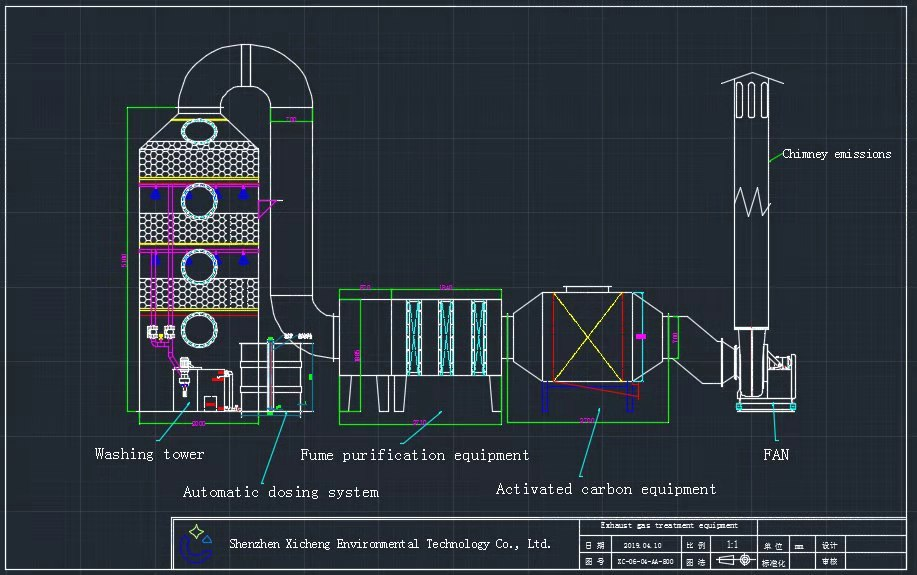
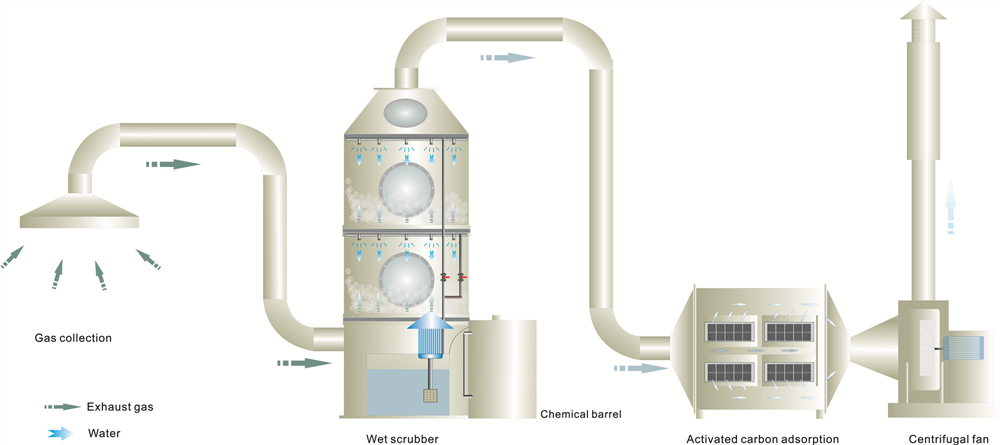
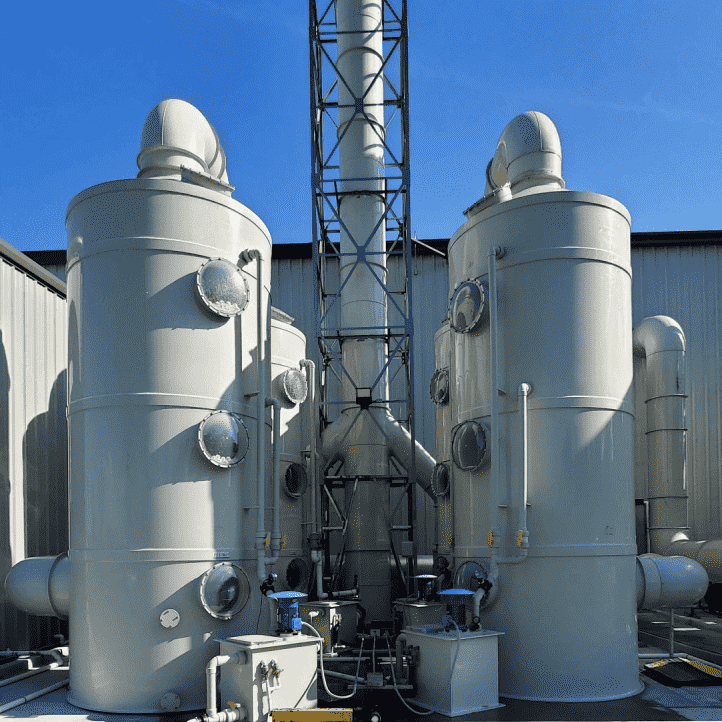
A galvanizing plant once asked for a “scrubber quote” as if the sizing problem had already been solved by naming the equipment class. The actual engineering question was still wide open. The gas stream carried hydrochloric acid fumes, the building had limited headroom, the utilities team wanted a realistic power budget, and the maintenance team had no interest in inheriting a tower that looked efficient on paper but dry-channeled in the field.
That is why scrubber design calculation engineering starts before the first formula and continues well after the first diameter estimate. A workable design is not just diameter, not just packing height, and not just reagent chemistry. A workable design is the point where gas velocity, liquid loading, transfer efficiency, pressure drop, material limits, and plant layout finally agree with each other.
Key Takeaways
- A scrubber design calculation is never one formula. Diameter, packed depth, liquid loading, pressure drop, and material limits interact, so the first-pass answer often fails one of the later checks.
- The minimum wetting rate check is where many bad packed-bed designs get exposed. If the calculated liquid flux cannot keep the media fully wetted, the tower can pass a spreadsheet review and still fail a stack test.
- Packed beds, spray towers, venturis, and crossflow scrubbers are not interchangeable labels for the same machine. Each geometry solves a different removal problem and imposes a different fan, pump, and maintenance burden.
- Material selection is part of the design calculation, not a purchasing detail. A PP shell may be the best-cost answer for acid gas below about 80°C, but the wrong temperature or chemistry can destroy that advantage in months.
- If a supplier cannot show the assumed gas velocity, L/G ratio, pressure drop, packing depth or spray-zone logic, and the material basis for the shell, the proposal is still a budget placeholder rather than an engineered design.
Introduction — What This Engineering Guide Covers
What this guide answers
Engineers tasked with sizing air pollution control equipment often hit a wall when transitioning from conceptual flowcharts to hard numbers. Sizing a wet scrubber is not as simple as picking a generic model out of a vendor catalog; it requires establishing vessel dimensions, liquid utility demands, and continuous energy burdens based entirely on the specific thermodynamic and chemical realities of your exhaust profile.
This hub article outlines the complete scrubber design calculation engineering workflow across all four primary wet scrubber geometries: packed bed, spray tower, venturi, and crossflow systems. By following this guide, you will gain the screening-level formulas, typical operating ranges, and decision frameworks necessary to establish a realistic baseline design before submitting a request for quotation to a fabricator.
Why scrubber design is a chain of checks, not one formula
Novice designers frequently search for a single, definitive equation to dictate the perfect scrubber size. In reality, industrial scrubber sizing is a highly iterative chain of interdependent calculations. You must first determine the baseline vessel diameter driven by the maximum allowable gas velocity, then calculate the liquid flow rate required for adequate chemical mass transfer or fine particulate impaction.
Those first-pass numbers rarely survive the entire calculation unbroken. As demonstrated in the worked HCl example later in this guide, an initial vessel diameter may fail a secondary wetting-rate check, forcing a redesign of the geometry or the liquid loading. A robust calculation forces you to cross-check gas limits against hydraulic limits until the entire system safely balances.
Where this pillar sits in the air-emissions scrubber knowledge base
This article serves as the primary engineering pillar for calculation and sizing. It delivers the overarching mathematical picture, while dedicated spoke articles dive into the exhaustive, step-by-step calculation methods unique to each individual scrubber type. If you are entirely new to the physical mechanisms of liquid-phase capture, start first with our foundational explainer on how a wet scrubber works.
If you have not yet finalized which scrubber geometry fits your specific pollutants, diving into math is premature. Sizing a high-velocity venturi throat for a soluble gas-absorption problem will result in a perfectly calculated engineering failure. In that scenario, step back and review our main guide on wet scrubber types and selection to confirm your technology choice before running any numbers.
The 5 Universal Inputs — Before You Touch a Formula
Gas flow rate, contaminant type, and inlet concentration
Before initiating any scrubber design calculation engineering workflow, you must lock down the physical and chemical baseline of the exhaust stream. Gas flow rate dictates the raw aerodynamic diameter of the vessel, while contaminant type and inlet concentration dictate the chemistry, removal mechanism, and liquid utility demand. Without establishing these three exact metrics, any sizing effort across a packed bed, spray tower, venturi, or crossflow system is guesswork disguised as engineering.
For example, the continuous gas flow rate for a steel pickling line exhaust typically runs between 5,000 and 15,000 m³/h, while a specialized batch chemical reactor vent might only generate 500 to 3,000 m³/h. If the contaminant is a highly concentrated, soluble gas like HCl at 500 ppmv, the design immediately pushes toward a packed bed with deep media. If it is submicron metallurgical particulate, the design pivots completely to the high-shear mechanics of a venturi.
Target removal efficiency, temperature, and available space
The final strict inputs define the regulatory boundaries and physical plant constraints. Target removal efficiency, often dictated by an environmental permit requiring 95% to 99% or greater control, determines the required mass-transfer depth for gas absorption or the aerodynamic pressure drop for particulate impaction. Simultaneously, inlet temperature and plant layout define the structural limitations of the vessel itself.
High temperatures fundamentally alter standard scrubber designs. If the exhaust exceeds the typical plastic limits of roughly 60°C to 80°C for PP and the higher range for FRP, you may need a quench stage, a material upgrade, or both. If you are designing for a crowded indoor mezzanine with low ceiling clearance, the space limit may force you to abandon a vertical counterflow tower in favor of a horizontal crossflow scrubber, which changes the math as well as the layout.
Quick-reference input table with typical industrial ranges
Process engineers use the following screening references to determine whether an exhaust stream falls within normal wet-scrubbing territory or requires special pretreatment before entering the primary vessel.
| Parameter | Typical Range (Screening Reference) | If Outside Range |
|---|---|---|
| Gas Flow Rate | 1,000 to 50,000 m³/h | Above 50,000 m³/h, evaluate parallel trains to avoid very large diameter vessels and oversized fans. |
| Inlet Temperature | Ambient to 80°C for PP; 120°C to 180°C for FRP depending on resin | Above the material limit, add quench duty or upgrade materials. |
| Target Removal Efficiency | 90% to 99.9% | Above 99.9%, expect multi-stage polishing, greater packing depth, or higher venturi pressure drop. |
| Contaminant Concentration | 10 to 2,000 ppmv for gas; 0.1 to 5 gr/dscf for particulate | Extreme loads often require pre-treatment such as cyclone separation, quench cooling, or staged chemistry. |
| Available Physical Space | Roughly 4.5 to 12 m vertical clearance for many tower systems | Limited height pushes the design toward crossflow or lower-profile staged solutions. |
Packed Bed Scrubber Design Calculation
Column diameter — Souders-Brown and the flooding constraint
The primary calculation in packed bed scrubber design establishes the internal column diameter based on the maximum allowable gas velocity. If the gas velocity is too low, the vessel becomes needlessly expensive. If it is too high, the upward aerodynamic force traps the falling liquid inside the packing, creating the operational failure known as flooding. Engineers define this safe boundary using the Souders-Brown equation.
The baseline calculation determines the flooding velocity: u_flood = K × sqrt((ρ_l − ρ_g) / ρ_g). For standard random packing, the capacity factor K typically ranges from 0.05 to 0.10 m/s. Once the theoretical flooding point is found, industrial designs immediately apply a safety margin, sizing the actual superficial gas velocity at 70% to 80% of flooding. This translates to a typical operating superficial velocity of 0.3 to 0.5 m/s. Finally, the column diameter is calculated as D = sqrt(4 × Q_g / (π × u_sg × 3600)), where Q_g is gas flow in m³/h.
Packed bed height — HTU-NTU method
Once the diameter dictates the aerodynamic capacity, the depth of the packed media dictates the chemical absorption efficiency. The industry-standard calculation is the Transfer Unit Method, which separates the difficulty of the chemical separation from the physical efficiency of the chosen packing media. The total required packing height is H_pack = NTU × HTU.
For dilute industrial gas streams, engineers calculate NTU = ln(y_in / y_out). As a rule of thumb, achieving 95% removal requires roughly 3.0 NTU, while 99% requires 4.6 NTU. The HTU value depends heavily on the chosen packing and gas solubility. For example, standard 2-inch polypropylene Pall rings scrubbing highly soluble HCl often exhibit an HTU between 0.5 and 0.8 meters under practical conditions.
Liquid-to-gas ratio and minimum wetting rate check
A packed bed can only achieve its theoretical mass-transfer efficiency if the plastic media is completely wetted. Dry plastic provides zero useful transfer area. To ensure full wetting, designers calculate the total liquid flow rate using a target liquid-to-gas ratio. For standard gas-absorption duties, the screening reference often ranges from 0.7 to 2.0 liters of liquid per cubic meter of gas. The raw recirculation flow is L = (L/G) × Q_g.
Critically, that liquid rate must then be checked against the physical geometry of the column using the Minimum Wetting Rate test. The liquid flux, L_flux = L / A_column, must be high enough to establish a continuous liquid film across the media. For standard 2-inch plastic random packing, the MWR threshold is often around 10 m³/(m²·h). If the calculated L_flux falls below this threshold, the diameter is too large for the liquid volume and the bed will dry-channel. At that point, you must either increase the pump flow or narrow the column diameter.
Quick-reference — diameter vs airflow table
The following table provides screening-level packed-bed diameters based on an assumed superficial gas velocity of about 250 fpm (1.27 m/s). It is a first-pass reference only. A full design still requires the thermodynamic, wetting, and pressure-drop checks described above.
| Gas Flow Rate (acfm) | Gas Flow Rate (m³/h) | Screening Diameter (ft) | Screening Diameter (m) |
|---|---|---|---|
| 2,000 | 3,400 | 3.2 | 1.0 |
| 5,000 | 8,500 | 5.0 | 1.5 |
| 10,000 | 17,000 | 7.1 | 2.2 |
| 20,000 | 34,000 | 10.1 | 3.1 |
| 50,000 | 85,000 | 16.0 | 4.9 |
Spray Tower Scrubber Design Calculation
Open-tower velocity limits and diameter sizing
Spray towers are mechanically simpler than packed beds: the contaminated gas moves upward through a completely open vessel while liquid atomizes and sprays downward. Because there is no internal packing media to restrict airflow or create a flooding hazard, the aerodynamic limits change significantly. While packed beds max out at a superficial gas velocity of around 0.5 m/s, open spray towers routinely and safely operate at internal gas velocities of 1.0 to 1.5 m/s.
This higher velocity limit fundamentally alters the scrubber design calculation engineering outcome: it allows for a much smaller column diameter for the exact same volumetric airflow, though this space-saving comes at the strict cost of lower chemical mass-transfer efficiency. To size the open vessel, engineers first determine the required cross-sectional area using A = Q / V, where A is area, Q is actual gas flow, and V is the design velocity. From there, the internal diameter is calculated using D = sqrt(4A / π).
Spray zone height, droplet sizing, and contact time
Without a physical media bed to artificially delay the rising gas, a spray tower’s pollutant capture efficiency depends entirely on raw aerodynamic contact time. The gas must remain in the active, wetted spray zone long enough to physically collide with or dissolve into the falling liquid droplets. For typical industrial gas scrubbing and thermal quenching applications, engineers often design for a contact time ranging between 1 and 3 seconds.
To calculate the required spray zone height, you multiply the design gas velocity by the target contact time, but you must also account for the terminal velocity of the atomized droplets. If the nozzles generate droplets that are too small, such as under 100 microns, the strong updraft can reverse their fall and push them out toward the stack. For a deeper qualitative explainer, review our guide on spray tower scrubber design.
L/G ratios for spray towers vs packed beds
Because an open spray tower does not contain large volumes of packing that demand continuous surface wetting, its liquid distribution logic is fundamentally different from a packed bed. The standard liquid-to-gas ratio for an open spray tower typically runs between 0.5 and 1.5 L/m³, which is usually lower than the packed-bed range because the tower only needs enough liquid to create a dense droplet field, not to wet a structured surface.
This lower liquid requirement directly reduces the capital cost and the continuous electrical burden of the recirculation system. During the initial scrubber design calculation engineering phase, you can determine the baseline pump flow using gpm = (L/G × Q) / 1000. Following that, estimate electrical load with hp = (gpm × head) / (3960 × η), where head is the total dynamic pressure required by the atomizing nozzles and η is pump efficiency.
| Spray Tower Parameter | Typical Screening Reference | Why It Matters |
|---|---|---|
| Gas Velocity | 1.0 to 1.5 m/s | Controls tower diameter and droplet carryover risk. |
| Contact Time | 1 to 3 seconds | Sets minimum spray-zone height for gas-liquid interaction. |
| L/G Ratio | 0.5 to 1.5 L/m³ | Determines droplet density and pump utility load. |
| Droplet Size | Often 100 to 500 microns | Balances gas absorption, particulate capture, and carryover control. |
Venturi Scrubber Design Calculation
Throat velocity and pressure drop — the core tradeoff
Venturi scrubbers operate on a different physical principle than static media beds. Instead of relying on slow gas absorption over a large surface area, a venturi forces gas through a converging-diverging throat at extreme speed to atomize the scrubbing liquid. This high-velocity shear relies on inertial impaction to capture submicron particulate that would otherwise slip through a standard packed tower.
The core scrubber design calculation engineering tradeoff here is pressure drop versus capture efficiency. To capture finer dust, you must accelerate the gas faster. The typical screening reference for throat velocity ranges from 60 to 120 m/s. Operating at the lower end often yields a pressure drop of 1,500 to 2,500 Pa. Pushing the throat to 120 m/s for aggressive submicron capture can drive the pressure drop up to 4,000 to 5,000 Pa, which sharply increases continuous fan horsepower.
Liquid injection rate and particulate capture
Because the contact zone inside a venturi throat is violently intense but extremely brief, the liquid distribution strategy shifts away from massive volume and toward atomization quality. The standard screening reference for venturi liquid-to-gas ratio sits between 0.5 and 1.5 L/m³. This is lower than a packed bed’s demand because the goal is not to wet a structural surface, but to generate a dense and uniform droplet cloud directly in the gas path.
If the liquid injection rate is too low, un-atomized voids allow fine particulate to bypass the collision zone. If it is too high, the excess liquid chokes the throat, wastes pump horsepower, and spikes pressure drop. Proper scrubber design calculation engineering requires balancing the L/G ratio so that droplet size and collision intensity match the target particulate diameter without overloading the fan.
When venturi beats packed bed
A venturi is the right engineering choice over a packed bed under three specific process conditions. First, it wins when the target particulate is submicron and highly sticky, a condition that would blind and destroy plastic packing. Second, it is useful when the incoming gas is dangerously hot and requires immediate evaporative quench. Third, a venturi can work well when the exhaust is a dirty mix of heavy particulate and soluble gas where a first-stage venturi plus downstream separator or absorber is justified.
Conversely, a packed bed beats a venturi when deep chemical gas absorption dictates permit compliance. The short residence time inside a venturi throat is mathematically insufficient for demanding chemical mass transfer. If the facility faces a tight electrical budget, the pressure-drop penalty of a venturi often disqualifies it and pushes the design toward a lower-velocity packed tower.
Crossflow Scrubber Design Notes
Horizontal vs vertical — what changes in the calculation
Crossflow scrubbers use the same gas-absorption principles as vertical packed beds, but they change the fluid geometry. Instead of gas rising vertically against falling liquid, a crossflow unit moves contaminated gas horizontally through the packing while liquid washes downward at a right angle. This is primarily a mechanical layout choice designed to solve physical plant constraints, not a separate physics category.
Transitioning to a horizontal vessel changes the scrubber design calculation engineering workflow in two important ways. First, you size the aerodynamic cross-section using horizontal face velocity rather than vertical superficial velocity, which removes the standard countercurrent flooding limit from the center of the math. Second, because the liquid and gas interact in two dimensions rather than in direct opposition, one-dimensional NTU formulas lose accuracy and designers often need crossflow-specific correction factors.
Face velocity, packing depth, and height-vs-footprint tradeoff
To maintain proper gas distribution without blowing the falling liquid out the back of the packing, engineers often target a horizontal face velocity between 200 and 400 fpm, roughly 1.0 to 2.0 m/s. Because crossflow mass transfer is less efficient than strong countercurrent contact, the physical packing depth in the direction of airflow is usually shallower, often limited to 0.6 to 1.5 meters so the spray headers can still wet the full media volume evenly.
The ultimate justification for this geometry is architectural. A standard vertical countercurrent scrubber sized for 10,000 m³/h may require 5 to 6 meters of vertical clearance. An equivalent crossflow unit can compress that height to roughly 3 meters, solving the headroom problem. The tradeoff is a footprint penalty: the horizontal unit may demand 30% to 50% more floor area.
Worked Example — HCl Packed Bed Scrubber at 10,000 m³/h
Step 1 — Define the inputs
Establishing a reliable baseline is the first mandatory step in any scrubber design calculation engineering workflow. For this worked example, the system is sized to treat the exhaust from a steel galvanizing plant’s acid pickling line. Every input must be tied to a physical source, because assumptions here usually create downstream failure.
The defined process inputs are a continuous gas flow rate of 10,000 m³/h, verified by the main exhaust fan rating plate; an inlet concentration of 120 mg/m³ of hydrogen chloride, verified by third-party stack sampling; and a gas temperature of 35°C, measured by a duct thermocouple. The local permit requires 95% removal, meaning the outlet concentration cannot exceed 6 mg/m³. To neutralize the acid, the facility supplies a 5% NaOH scrubbing solution.
Step 2 — Select packing and calculate diameter
With the physical properties locked in, 2-inch polypropylene Pall rings are selected as the mass-transfer media because they balance chemical resistance and low pressure drop. To determine the column diameter, apply the Souders-Brown equation using a capacity factor of K = 0.06 m/s for standard packed beds. To stay clear of flooding, apply a 75% safety factor to the theoretical flooding limit.
Applying that safety margin to the 10,000 m³/h flow yields an initial theoretical internal diameter of 1.63 meters. In standard industrial fabrication, odd fractional diameters increase manufacturing cost, so the first-pass design rounds to a practical vessel diameter of 1.6 meters. This gives a total internal cross-sectional area of 2.01 m².
Step 3 — Calculate packed height
The depth of the packing dictates the chemical absorption efficiency. Start by calculating the Number of Transfer Units: NTU = ln(120 / 6) = 3.0. For a reactive absorption process like HCl neutralized by NaOH over 2-inch Pall rings, a practical Height of a Transfer Unit is approximately 0.5 meters.
The active packed height is therefore H_pack = NTU × HTU = 1.5 m. However, a physical column requires transition space. Add 0.3 meters above the packing for the liquid distribution headers and 0.3 meters below the packing for gas distribution. The total packed section becomes 2.1 meters.
Step 4 — Size the recirculation system (with MWR iteration)
First-pass dimensions rarely survive the hydraulic checks in a proper scrubber design calculation engineering workflow. Begin with an assumed liquid-to-gas ratio of 0.9 L/m³, which gives a recirculation flow of 9,000 L/h. Now run the Minimum Wetting Rate check: L_flux = 9 / 2.01 = 4.5 m³/(m²·h). Because 2-inch Pall rings typically require roughly 10 m³/(m²·h) to stay fully wetted, this initial design fails. The bed will dry-channel and let HCl escape.
The design must iterate. If the L/G is pushed to 2.0, the liquid flow jumps to 20 m³/h and the wetting check passes, but the pump duty becomes excessive for a relatively light 120 mg/m³ HCl load. Instead, reduce the column diameter to 1.4 meters, which gives an area of 1.54 m². At an optimized L/G of 1.5, the flow becomes 15,000 L/h and the new check yields L_flux = 15 / 1.54 = 9.7 m³/(m²·h). That is within 3% of the target MWR and is acceptable with a high-quality liquid distributor.
Step 5 — Pressure drop check
With the geometry and fluid dynamics finalized, calculate the aerodynamic resistance to size the exhaust fan. For 2-inch Pall rings operating at roughly 1.33 m/s and an L/G ratio of 1.5, the media generates a pressure drop of approximately 250 to 350 Pa per meter of depth. Multiplying this by the 1.5-meter active packed bed yields 375 to 525 Pa of resistance.
The packing is not the only restriction in the vessel. Add an estimated 100 to 150 Pa to account for the chevron demister and the inlet/outlet transitions. That brings the total system pressure drop to roughly 500 to 700 Pa. To overcome this total static pressure while moving 10,000 m³/h, the facility should install a standard 3 kW centrifugal exhaust fan.
Step 6 — Final design summary table
After completing the iterative scrubber design calculation engineering workflow, the raw inputs have been converted into a complete baseline specification. This is the level of detail a fabrication vendor needs to generate a realistic quotation.
| Design Parameter | Final Specification |
|---|---|
| Scrubber Type | Vertical countercurrent packed bed |
| Column Diameter | 1.4 meters |
| Packing Type | 2-inch polypropylene Pall rings |
| Active Packed Depth | 1.5 meters |
| Total Packed Section Height | 2.1 meters |
| L/G Ratio | 1.5 L/m³ |
| Recirculation Flow | 15,000 L/h (15 m³/h) |
| Recirculation Pump | Matched to 15 m³/h with moderate head |
| Total System ΔP | 500 to 700 Pa |
| Main Fan Motor | 3 kW centrifugal fan |
| Chemical Reagent | 5% NaOH solution |
| Design Removal Efficiency | 95% guaranteed (outlet ≤ 6 mg/m³) |
Scrubber Type Comparison — Decision Table
Packed bed vs spray tower vs venturi vs crossflow at a glance
Selecting the correct scrubber geometry is the single most critical decision in the workflow, because no amount of mathematical optimization can force a venturi to efficiently absorb a highly soluble gas or a packed bed to physically capture submicron dust. This comparison matrix collects the physical, thermodynamic, and financial tradeoffs of the four primary wet scrubber designs into one screening tool.
Using this table, engineers can eliminate incompatible technologies before investing hours into detailed scrubber design calculation engineering. Once the baseline geometry is confirmed, the design process can safely advance to the volumetric and hydraulic sizing formulas required for that exact vessel type.
| Type | Best For | Typical ΔP | L/G Range | Approx Height | Footprint Need | Relative Equipment Cost | Best When… |
|---|---|---|---|---|---|---|---|
| Packed Bed (Counterflow) | Highly soluble or reactive gases | 1 to 6 in. w.c. | 0.7 to 2.0 L/m³ | Tall | Small | Medium | Deep chemical absorption is required and the gas is free of heavy sticky dust. |
| Spray Tower | Heavy sludge, sticky resins, extreme heat | 1 to 3 in. w.c. | 0.5 to 1.5 L/m³ | Medium to tall | Small | Low | Gas is dirty, hot, or solids-laden enough to foul a packed bed quickly. |
| Venturi | Submicron particulate capture | 10 to 60+ in. w.c. | 0.5 to 1.5 L/m³ | Medium | Medium | High | Fine dust capture is mandatory or the unit is used as a heavy-duty prescrubber. |
| Crossflow (Horizontal) | Soluble gases in height-limited spaces | 1 to 4 in. w.c. | 0.7 to 2.0 L/m³ | Short | Large | Medium to high | Vertical headroom is capped by the building, but gas absorption is still required. |
How to choose based on pollutant type, space, and budget
The baseline decision framework always begins with pollutant phase. If the target is chemical gas absorption, the choice narrows immediately to a packed bed or an open spray tower. If the process emits fine submicron particulate, high-velocity impaction through a venturi is often mandatory. If the exhaust contains a severe mix of both abrasive dust and toxic gas, a staged system may be required: a venturi to knock down solids followed by a packed bed to absorb the gas.
Once pollutant behavior is clear, space constraints finalize the layout. Facilities with very limited ceiling height may have to pivot to a crossflow design, while sites with limited floor area usually benefit from a vertical counterflow tower. The final filter in the decision matrix is the tradeoff between initial capital cost and long-term operating burden. A simple spray tower may cost less up front, while a packed bed often delivers lower long-run fan cost for gas duty.
Material Selection for Scrubber Construction
PP, FRP, SS304, SS316, Hastelloy — the five materials
Selecting the correct material of construction is a first-order decision that finalizes the scrubber design calculation engineering workflow. You can perfectly calculate the aerodynamics of a venturi throat or the mass-transfer depth of a packed bed, but if you specify the wrong material for the incoming process chemistry, the scrubber may degrade into scrap within months.
The industrial wet-scrubbing market is dominated by five core materials: polypropylene, fiberglass reinforced plastic, 304 stainless steel, 316 stainless steel, and Hastelloy C276. Each material represents a tradeoff between thermal tolerance, corrosion resistance, and capital cost.
| Material | Max Temp | Acid Resistance | Alkali Resistance | Relative Cost | Weight | Repairability |
|---|---|---|---|---|---|---|
| Polypropylene (PP) | 80°C | Excellent | Excellent | 1× baseline | Light | High |
| FRP (Vinyl Ester) | 120°C to 180°C | Very good | Good to excellent | 1.5× to 2× | Medium | Moderate |
| 304 Stainless Steel | 400°C+ | Poor in chlorides | Good | 2.5× | Heavy | High |
| 316 / 316L Stainless Steel | 400°C+ | Moderate | Good | 3.5× | Heavy | High |
| Hastelloy C276 | 400°C+ | Extreme | Excellent | 15×+ | Heavy | Difficult |
When PP is enough — and when it isn’t
Polypropylene is the default material for a large share of industrial acid-gas scrubbing because it resists HCl, dilute sulfuric acid, HF, and sodium hydroxide at relatively low cost. In practical terms, PP is often the most economical answer for metal-finishing, pickling, and general acid-fume control below about 80°C.
PP fails when the exhaust profile pushes outside those limits. If the gas temperature rises beyond its structural comfort zone, if organic solvents are present, or if the unit must survive cold outdoor conditions without protection, the design needs to step up in material grade. For high-temperature or structurally demanding service, FRP often becomes the required alternative. For selected aggressive chemical environments, especially where halides and heat combine, stainless may still be the wrong answer and exotic alloys may be the only survivable option. For related chemical-duty context, see our page on caustic scrubber systems.
Common Design Mistakes and How to Avoid Them
Skipping the minimum wetting rate check
The most common and expensive error in packed-bed sizing is finalizing the liquid pump flow without verifying the Minimum Wetting Rate. Engineers sometimes calculate the liquid-to-gas ratio based only on stoichiometry, forgetting that this liquid must physically spread across the entire surface area of the chosen media to be effective.
When this hydraulic check is skipped, dry patches form inside the column and the chemical mass transfer collapses, often unnoticed until a stack test fails. To prevent this, always calculate L_flux = L / A_column and verify it exceeds the packing’s MWR threshold. If it fails, iterate the vessel diameter or the L/G ratio, exactly as shown in the worked example above.
Designing at flooding velocity without safety factor
Pushing a scrubber diameter to its absolute aerodynamic limit to save capital cost is a high-risk shortcut. When designers calculate the theoretical flooding point and then size the vessel to run directly at that maximum velocity, they leave no operating margin for real process fluctuations.
In reality, a small surge in exhaust flow or a slight over-pressurization from the recirculation system can choke the column and push liquid out toward the stack. Good scrubber design calculation engineering applies a 70% to 80% safety derating to theoretical flooding velocity. The capacity factor in the Souders-Brown equation already reflects decades of practical experience.
Ignoring gas temperature effects on material and velocity
Assuming ambient conditions for a hot process exhaust invalidates both the aerodynamic math and the structural integrity of the equipment. Gas temperature directly affects gas density; hotter gas means lower density, which increases actual volumetric flow and internal velocity for the same mass flow basis.
Beyond aerodynamics, temperature also dictates material survival. Standard PP loses structural margin as process temperature approaches 80°C. If a 90°C unquenched exhaust is routed into a standard PP shell, deformation or outright failure is a realistic outcome. Temperature must therefore be treated as both a hydraulic and a materials variable.
Treating all scrubber types as interchangeable
Buyers sometimes attempt to substitute one scrubber geometry for another purely on capital price, assuming that any vessel spraying water will accomplish the same regulatory task. A spray tower is not simply a cheaper packed bed, and a venturi is not just a high-efficiency spray tower. Each geometry solves a different physical problem.
Trying to force a geometry to do a job it was not designed for can lock the plant into high operating cost and poor performance at the same time. That is why the type-comparison logic earlier in this guide matters before the detailed math begins.
Frequently Asked Questions
How do I calculate scrubber diameter?
To calculate scrubber diameter, first determine the maximum allowable internal gas velocity. For packed beds, this usually means using the Souders-Brown equation and then derating the theoretical flooding point to 70% to 80% of that value. Once the target velocity is set, divide the actual gas flow by that velocity to determine cross-sectional area, then convert that area into diameter.
For an open spray tower, the allowable velocity is higher, so the vessel can be narrower for the same airflow. The packed-bed section of this guide gives the baseline formulas and a screening table.
What is the HTU-NTU method for packed bed height?
The HTU-NTU method is the standard scrubber design calculation engineering approach used to determine how deep a packed bed must be. It separates the difficulty of the separation itself from the physical efficiency of the selected media.
First calculate NTU = ln(y_in / y_out) based on inlet and target outlet concentrations. Then multiply that NTU value by the Height of a Transfer Unit for the chosen media and chemistry. The result gives the active packed height required.
How do I choose between packed bed, spray tower, venturi, and crossflow?
The choice depends on pollutant type, plant layout, and operating-cost tolerance. If you need efficient soluble-gas absorption, choose a packed bed. If the exhaust is hot, dirty, or heavily solids-laden, a spray tower often makes more sense. If submicron fine particulate is the main issue, a venturi is usually the right answer.
If efficient gas absorption is needed but vertical space is severely limited, crossflow becomes the layout solution. The decision table earlier in this guide summarizes the tradeoffs at a glance.
What is the typical pressure drop of a wet scrubber?
Pressure drop varies sharply by geometry. A standard packed bed often generates roughly 100 to 400 Pa per meter of packing depth. Open spray towers are lower-resistance devices, often operating between about 50 and 200 Pa. Venturi scrubbers are much higher, commonly falling in the 1,500 to 5,000+ Pa range because their particulate capture depends on high throat velocity.
Those ranges are screening references, not universal guarantees. Actual pressure drop depends on liquid rate, internals, fouling condition, and operating point.
How much does a gas scrubber cost to build?
For a standard PP counterflow packed bed in the 5,000 to 15,000 m³/h range, base ex-works equipment cost often falls between about $8,000 and $25,000. Fabrication in Europe or North America can push the capital price significantly higher than Asian manufacturing.
Capital cost is only the starting point. Installation, ductwork, and electrical work often add 50% to 100% to the equipment cost. Operating cost then adds recurring fan and pump electricity, plus chemical consumption for reactive gas duty.
Detailed Scrubber-Specific Design Guides
For dedicated design calculation guides on specific scrubber types, see the following articles:
- Packed Bed Scrubber Design Calculation: Step-by-Step with Formulas
- Spray Tower Scrubber Design Calculation and Sizing Guide
- Ammonia Scrubber Design Calculation: Sizing Guide with Worked Example
- H2S Scrubber Design Calculation: Caustic Sizing for Biogas and Industrial Gas
- Chlorine Scrubber Design Calculation: Continuous and Emergency Sizing
- Scrubber Pressure Drop Calculation: Packed Bed, Spray Tower, and Venturi Methods
- Acid Fume Scrubber Design: HCl, HF, H2SO4, and Mixed Acid Systems
Next Steps — Where to Go From Here
Use this pillar to choose the right calculation path
This guide is designed to help you choose the right scrubber type, understand the screening math, and recognize where real design iteration begins. If your process already points clearly toward a specific geometry, the next move is to shift from pillar-level screening into type-specific engineering detail.
For general wet-scrubber selection logic, review our wet scrubber types and selection guide. If you need a product-level starting point for fabrication scope and pricing, browse the live wet scrubber product catalog. If your case is dominated by general operating principle rather than sizing math, revisit how a wet scrubber works.
Match the spoke article to the actual design problem
If your project is clearly a packed-bed duty, use this pillar as the screening baseline and then move into the detailed packed-bed calculation workflow. If your gas stream is hotter, dirtier, or more solids-laden, compare that path against the spray-tower route before committing to media. If vertical headroom is the limiting factor, the crossflow branch deserves a separate review before the vessel outline is frozen.
The right next question is not “what scrubber do we sell”. The right next question is which geometry can satisfy the pollutant duty, fit the building, survive the chemistry, and stay inside the pressure-drop and utility budget at the same time. That is the point where engineering review becomes worth far more than a low first quote.
Written by Corbin, Applications Engineer at XICHENG EP Ltd. — 10+ years designing and commissioning industrial exhaust gas treatment systems across 30+ countries and 500+ installations. Corbin has worked on packed-bed absorbers, spray towers, crossflow layouts, and staged wet scrubber systems for acid gas, fume, and particulate control, and has seen how often projects go off track when buyers ask for a scrubber before defining the actual hydraulic and chemical limits.
Sources
EPA and selected technical references