
Is a Wet Scrubber the Right Choice for Your Gas Stream?
A wet scrubber is not selected by airflow alone. Gas solubility, pollutant loading, temperature, moisture, dust, required outlet concentration and wastewater handling all affect the configuration. Use the guide below as a first screen; final selection requires project data.
Usually a good fit
- Water-soluble or chemically reactive gases
- Acid fumes such as HCl and selected sulfur compounds
- Ammonia, chlorine, H2S and mixed industrial odors
- Streams that benefit from gas cooling or humidification
Needs engineering review
- Mixed acid and alkaline contaminants
- High dust or sticky particulate loading
- Hot gas, condensation or variable batch releases
- Strict outlet limits or limited wastewater capacity
Another technology may fit better
- Poorly soluble VOCs without a suitable reaction route
- Applications where no liquid effluent can be accepted
- Dry particulate control with no soluble gas component
- Streams requiring recovery rather than neutralization
Wet Scrubber Selection Summary
The likely configuration depends on what must be removed and how the process behaves. The examples below are starting points, not guaranteed designs.
| Process condition | Likely starting point | Why it is considered | Confirm before quotation |
|---|---|---|---|
| Soluble acid gas or chemical fume | Packed bed scrubber | Provides gas-liquid contact area for absorption and reaction | Gas composition, concentration, reagent, outlet requirement |
| High airflow with readily soluble gas | Spray tower | Open flow path and direct gas-liquid contact | Droplet separation, liquid rate, footprint and pressure allowance |
| Low ceiling or restricted vertical space | Horizontal/crossflow scrubber | Reduces overall equipment height | Available length, duct routing, drainage and maintenance access |
| Mixed gases or demanding outlet target | Multi-stage system | Allows different chemistry or contact conditions by stage | Contaminant interactions, pH zones, controls and blowdown |
| Gas plus heavy particulate loading | Pre-treatment plus scrubber | Helps protect packing and reduce plugging risk | Particle size, solids loading, stickiness and cleaning plan |
Manufacturer Support Before You Order
XICHENG EP LTD engineers and fabricates custom PP and FRP industrial wet scrubber systems in Shenzhen, China. We support packed bed scrubbers, acid fume scrubbers, H2S scrubber systems, ammonia scrubbers, odor control scrubbers and water scrubber systems where water absorption is technically suitable.
Application Review Before Sizing
The proposed configuration is reviewed against your pollutant, airflow, temperature, inlet load, outlet target and site constraints—not airflow alone.
Custom PP and FRP Fabrication
Tower material, connections, access points, pump duty and optional controls are confirmed on the approved project drawing before fabrication.
Inspection and Purchase Documents
Your quotation can define inspection evidence, drawings, equipment scope, warranty terms and the applicable CE documentation for the supplied assembly.
Request a Wet Scrubber Engineering Proposal
Tell us what must be removed and how the gas stream operates. We will review the application before recommending a configuration. You do not need to have every value; clearly identify unknown data and the project stage.
What You Receive
- Preliminary scrubber configuration and treatment approach
- Material recommendation and preliminary size basis
- Defined equipment scope, options and document requirements
- Budget quotation and project-specific production schedule
Any assumptions and missing process data will be identified clearly for your review.
What to Send
- Pollutant name and concentration
- Normal and maximum airflow
- Gas temperature and humidity
- Required outlet or removal target
- Operating hours and peak duration
- Preferred material, if specified
- Available footprint and utilities
- Destination country and required timing
Your information is used to assess this project and prepare a response. Final performance, scope and commercial terms are confirmed in the formal proposal.
Wet Scrubber Specifications and Size Range
Use these specifications to shortlist a tower size and prepare your budget. Your final model is selected from the gas composition, normal and peak airflow, temperature, removal target and available footprint. The approved quotation and drawing will confirm the dimensions, material, pump and performance.
| Parameter | Standard range or option | What we confirm for your project |
|---|---|---|
| Product family / model | XC-1 / XC-01 custom wet scrubber | The final model code will identify the approved configuration and operating duty |
| Airflow | 3,000–48,000 m³/h per standard vertical tower | For higher airflow, we will assess one larger custom tower or parallel units |
| Tower diameter | 800–3,000 mm | Selected from gas velocity, contact section, pressure drop and site constraints |
| Overall tower height | 4,200–5,500 mm | Packing depth, access, demister and available headroom can change the final height |
| Shell / bottom thickness | 8–12 mm shell; 8–15 mm bottom for the PP series | Final thickness considers vessel diameter, pressure or vacuum, wind, transport and supports |
| Construction materials | PP standard; PPH, FRP and stainless-steel options | We confirm the polymer, resin or metal grade against temperature and chemical exposure |
| Pump power | 0.75–7.5 kW for the standard vertical range | Selected from circulation rate, head, piping loss, material and standby requirements |
| Packed-bed pressure drop | Typically 300–800 Pa | Confirmed from packing, bed depth, gas velocity, liquid loading and fouling allowance |
| Liquid-to-gas ratio | Typically 1.5–3.0 L/m³ for packed-bed systems | Adjusted to suit the absorption chemistry and required mass transfer |
| Packing options | Pall rings, polyhedral balls, structured packing, ceramic saddles, tellerettes and Tri-Packs | Specific surface area typically ranges from 100–350 m²/m³ by packing type and size |
| Operating temperature | PP up to 80°C continuous; FRP up to 120°C continuous, subject to material grade | We confirm the exact polymer or resin, chemical concentration and structural derating; a quench stage can be added when required |
| Automation options | pH-controlled dosing; pH/ORP, blowdown and level control options | Control philosophy and instruments must be listed in the quotation |
Standard vertical units cover 3,000–48,000 m³/h per tower. For higher airflow, we will evaluate a larger custom tower or parallel units based on transport limits, pressure drop and your site layout.
Vertical PP Series — Preliminary Size Selection
| Airflow (m³/h) | Diameter (mm) | Height (mm) | Shell / bottom (mm) | Tank (mm) | Connection (mm) | Pump (kW) |
|---|---|---|---|---|---|---|
| Up to 4,000 | 800 | 4,200 | 8 / 8 | 700×550×H600 | 315 | 0.75 |
| 4,000–5,500 | 1,000 | 4,200 | 8 / 10 | 750×600×H600 | 400 | 1.5 |
| 5,500–8,000 | 1,200 | 4,200 | 8 / 10 | 750×600×H600 | 500 | 1.5 |
| 8,000–12,000 | 1,500 | 4,700 | 8 / 10 | 750×600×H600 | 600 | 2.2 |
| 12,000–17,000 | 1,800 | 5,100 | 10 / 10 | 850×600×H700 | 650 | 4.0 |
| 17,000–21,000 | 2,000 | 5,100 | 10 / 12 | 850×600×H700 | 700 | 4.0 |
| 21,000–25,000 | 2,200 | 5,200 | 10 / 12 | 950×600×H700 | 750 | 4.0 |
| 25,000–32,000 | 2,500 | 5,200 | 12 / 12 | 950×600×H700 | 800 | 5.5 |
| 32,000–40,000 | 2,800 | 5,500 | 12 / 15 | 1,000×700×H700 | 900 | 7.5 |
| 40,000–48,000 | 3,000 | 5,500 | 12 / 15 | 1,000×700×H700 | 1,000 | 7.5 |
A typical vertical configuration uses two spray layers, one demisting layer, a 400–500 mm viewing window, DN63 drainage and a 25 mm water-makeup connection. Your approved drawing and bill of materials will show the exact arrangement supplied.
Gas Removal Performance
The values below show typical performance targets when the pollutant is matched to the correct scrubbing liquid and operating conditions. Your proposal will define the design inlet load, outlet target, reagent, utilities and acceptance method for your application.
| Target pollutant | Typical scrubbing liquid / reagent | Typical removal target | What affects performance |
|---|---|---|---|
| Hydrogen chloride (HCl) | Water / NaOH solution | 90–95% / 95–99% | Inlet concentration, liquid pH, contact time, chloride loading |
| Hydrogen fluoride (HF) | Water / NaOH solution | 90–95% / 95–99% | Material compatibility, concentration, reagent control and solids |
| Ammonia (NH₃) | Water / dilute sulfuric acid | 90–95% / over 99% | Acid dosing, ammonium salt concentration, blowdown and mist removal |
| Sulfur dioxide (SO₂) | NaOH solution | 95–99% | Inlet load, alkali strength, oxidation state and wastewater route |
| Chlorine (Cl₂) | NaOH-based solution | 95–99% | Release case, chemical stability, oxidation-reduction control and safety basis |
| Hydrogen sulfide (H₂S) | NaOH-based solution | 95–99% | Peak load, oxygen/methane, pH/ORP, oxidant strategy and polishing need |
| Sulfuric acid mist (H₂SO₄) | Water | 95–99% | Droplet-size distribution, entrainment and demister design |
| Chromic acid mist (CrO₃) | Water | 95–99% | Hexavalent chromium handling, mist size, wastewater and local requirements |
| Nitric acid fume (HNO₃) | Water | 90–99% | NOx fraction, temperature, gas chemistry and required outlet |
Ordering, Inspection and Documentation
| Item | Available option or typical term | What your quotation will confirm |
|---|---|---|
| Minimum order | 1 complete set | The included equipment, accessories and exclusions |
| Customization | Built to the approved project drawing | GA drawing, nozzle orientation, service clearances and connection standard |
| Warranty | Typical term: 1 year | Start date, covered parts, labor, freight and consumable exclusions |
| Inspection documents | Test report and outgoing-inspection video can be provided | Required hold points, leak test, dimensional check, motor and pump data, and document language |
| Expected PP equipment life | Typically 8–10 years under suitable service conditions | Actual life depends on chemistry, UV exposure, temperature, cleaning and maintenance; this is separate from the warranty term |
| Color | Beige or dark grey | Material grade, UV stabilization and final color approval |
| Fabrication time | Typically 7–35 days after technical approval | The final production and delivery schedule for your order |
| CE documentation | Wet scrubber certificate M.2025.206.C123948, listed validity 2025-08-06 to 2030-08-05 | Request a copy and confirm that your supplied assembly falls within its stated scope |
What We Need to Size Your Scrubber
A reliable quotation connects the equipment configuration to your operating data. These are the inputs that change scrubber size, materials, chemical consumption and system boundary.
| Input | Why it matters | Useful format |
|---|---|---|
| Pollutant and gas composition | Determines absorption chemistry, compatibility and staging | Chemical names plus normal and peak concentration |
| Normal and maximum airflow | Sets hydraulic loading, vessel size and fan duty | m³/h, Nm³/h or CFM with stated conditions |
| Temperature, humidity and pressure | Affects material selection, evaporation and gas volume | Normal, minimum and maximum values |
| Required outlet | Defines the performance objective used for engineering | Outlet concentration, removal target or local limit |
| Operating profile | Changes control strategy and chemical demand | Hours/day, days/year, continuous or batch, peak duration |
| Site and utility constraints | Defines layout and package boundary | Footprint, height, power, water, drainage and ambient conditions |
What Can Be Included in Your Scrubber Package
Your quotation will clearly list what we supply and what remains under the buyer or contractor. The options below help you decide whether you need only the scrubber vessel or a more complete treatment package.
Core package may include
- Scrubber vessel and internal supports
- Spray distribution or packed contact section
- Mist eliminator and access points
- Recirculation tank and piping within the package
- Pump selection for the agreed duty
Project options
- pH/ORP monitoring and chemical dosing
- Duty/standby pumps and instrumentation
- Fan, damper and local control panel
- Two-stage treatment or polishing
- Skid assembly, platforms and access ladders
Confirm responsibility
- Site ductwork and stack connection
- Foundations, lifting and installation labor
- Power, water, reagent and wastewater tie-ins
- Local permits and emission testing
- Commissioning support and spare parts
Construction Materials Are Selected by Chemistry
Material choice is based on the actual liquid and gas environment, including reagent, contaminants, concentration, temperature, abrasion and upset conditions. A material named below is an option, not an automatic recommendation.
Polypropylene (PP)
Often evaluated for corrosive chemical fumes where the operating temperature and structural duty suit thermoplastic construction.
Fiberglass-reinforced plastic (FRP)
Often evaluated where structural stiffness, vessel size and a project-specific corrosion barrier are important.
Dual laminate or metal options
Considered when the chemistry, temperature, pressure, mechanical duty or owner specification requires another construction system.
Available Wet Scrubber Configurations
Packed Bed Scrubber
Uses packing to increase gas-liquid contact. It is commonly evaluated for soluble or reactive gases where absorption and chemical reaction control the design.
Spray Tower Scrubber
Uses spray nozzles in an open vessel. It can suit readily soluble gases, gas cooling and applications where a more open gas path is preferred.
Horizontal / Crossflow Scrubber
Moves gas horizontally through the contact section. It is evaluated where building height, duct routing or service access favors a low-profile arrangement.
A two-stage arrangement can separate incompatible chemistries or provide a polishing step. Heavy dust, aerosols or sticky solids may require a pre-stage and a specific cleaning strategy.
Industrial Applications
| Application | Typical contaminants | Questions to resolve |
|---|---|---|
| Chemical processing and storage vents | Acid gases, alkaline fumes, reactive vapors | Normal versus emergency release, concentration range, reagent |
| Electroplating and surface treatment | Acid mist and process fumes | Carryover droplets, hood capture, mixed bath chemistry |
| Wastewater, sludge and biogas facilities | H2S, ammonia and odor compounds | Peak load, oxygen, methane, moisture and polishing need |
| Electronics, laboratory and pharmaceutical exhaust | Low-volume chemical fumes and mixed batch emissions | Batch schedule, segregation, redundancy and building constraints |
| Fertilizer and nitrogen-chemical processes | Ammonia and alkaline aerosol | Concentration, acid selection, salt management and blowdown |
From Process Data to a Buildable Proposal
- Application review
Confirm contaminants, operating cases, target and unknowns. - Preliminary selection
Choose the likely configuration, chemistry and material basis. - Scope definition
Agree package boundary, controls, utilities and documentation. - Formal quotation
Issue project-specific technical and commercial terms for review.
After you place the order, we will follow the agreed schedule for drawings, fabrication, inspection, packing and shipping. Your quotation will show the project-specific production timeline so you can coordinate installation and plant planning.
Installed System Examples
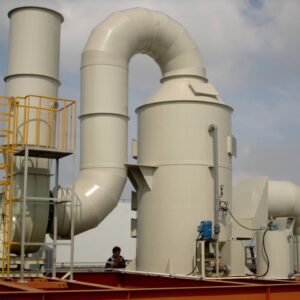
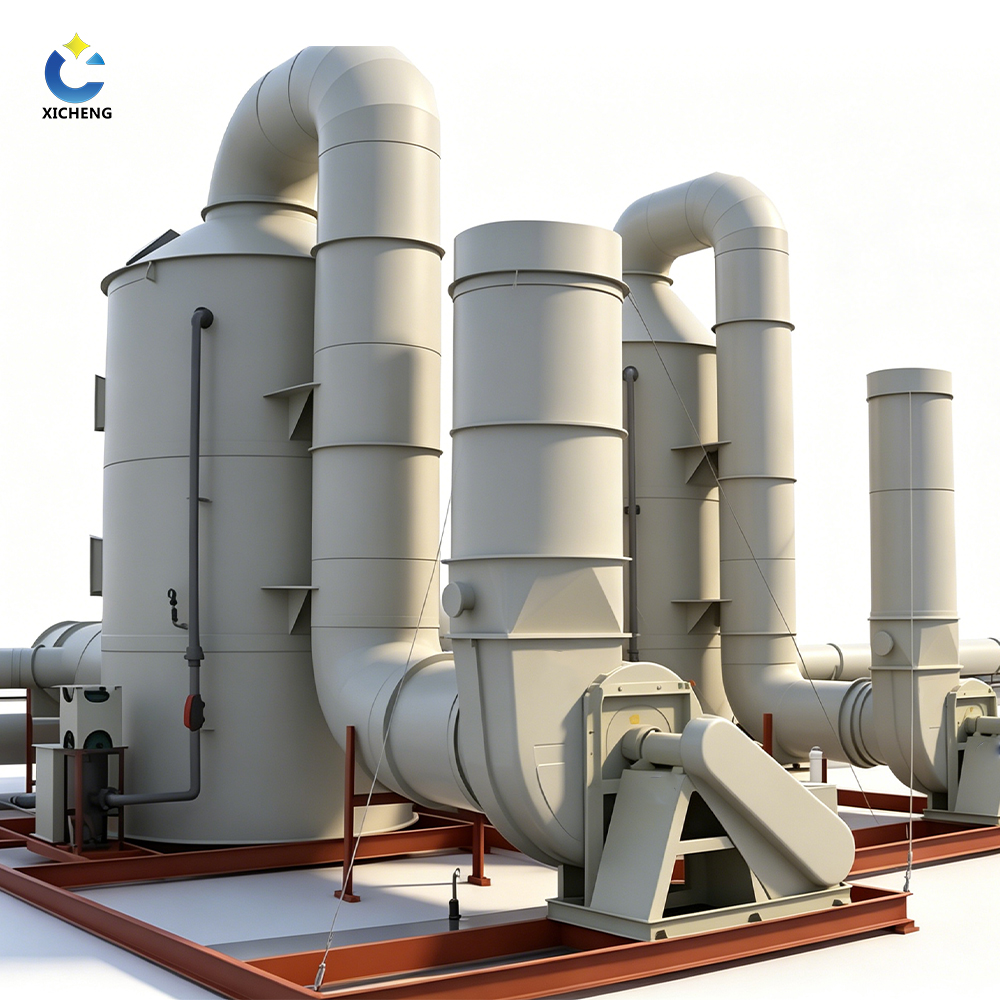
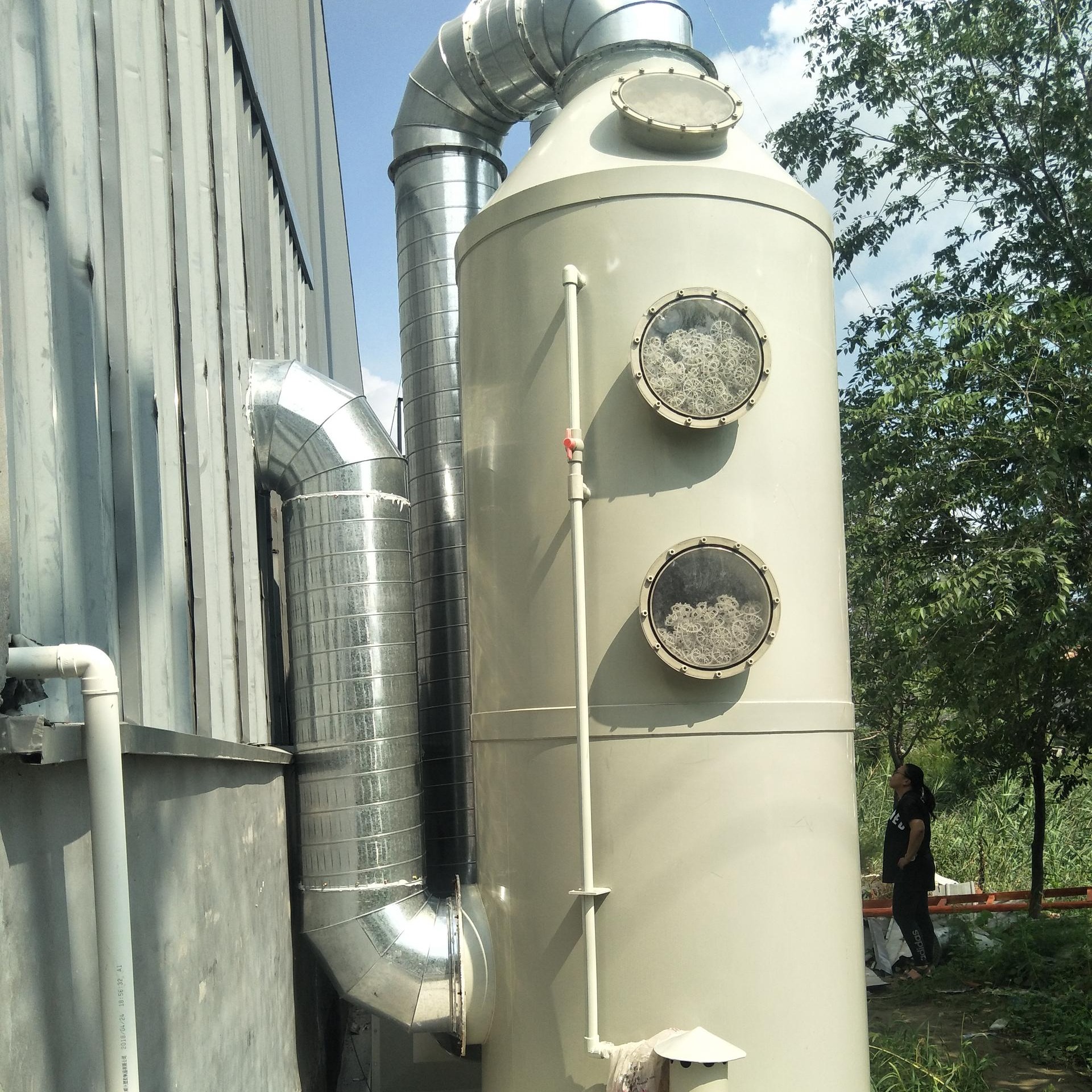
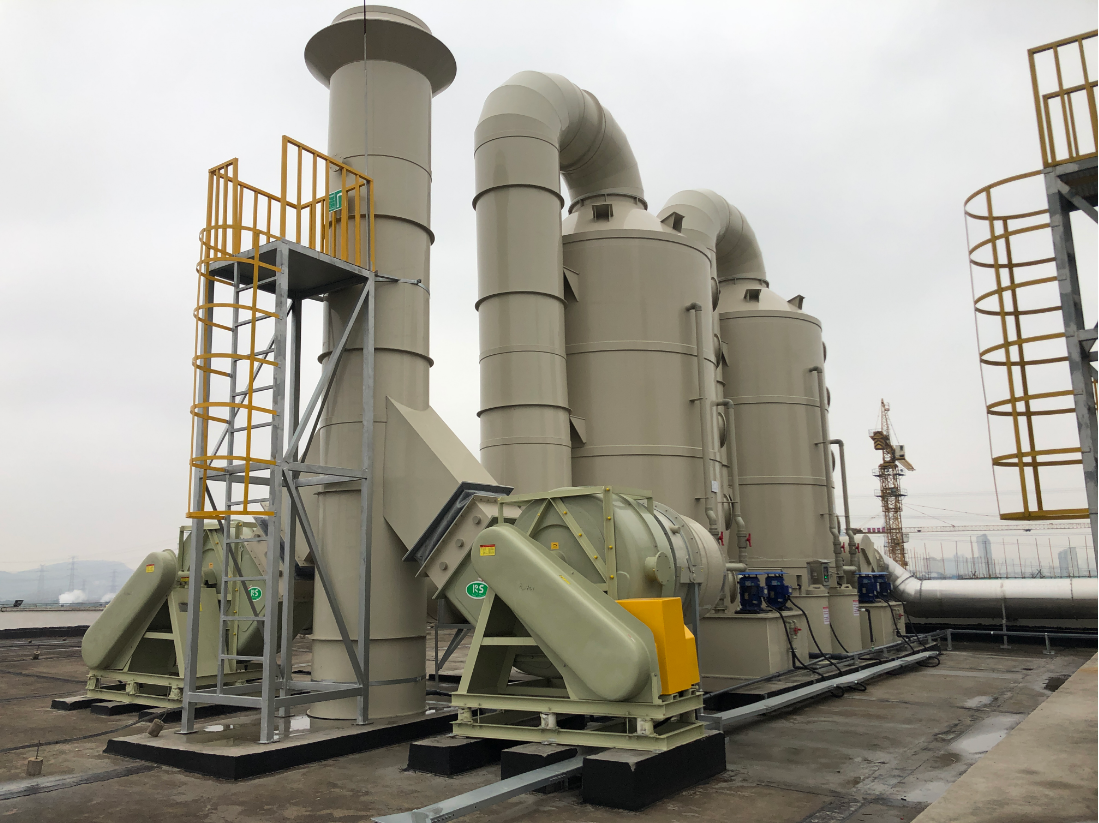
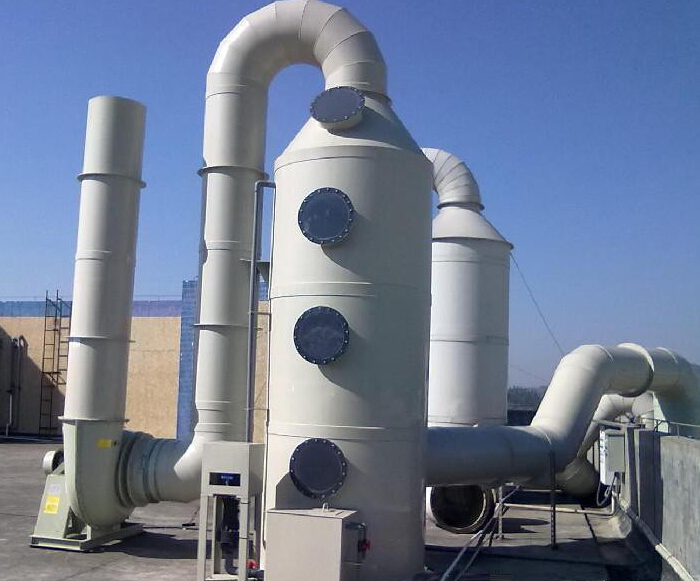
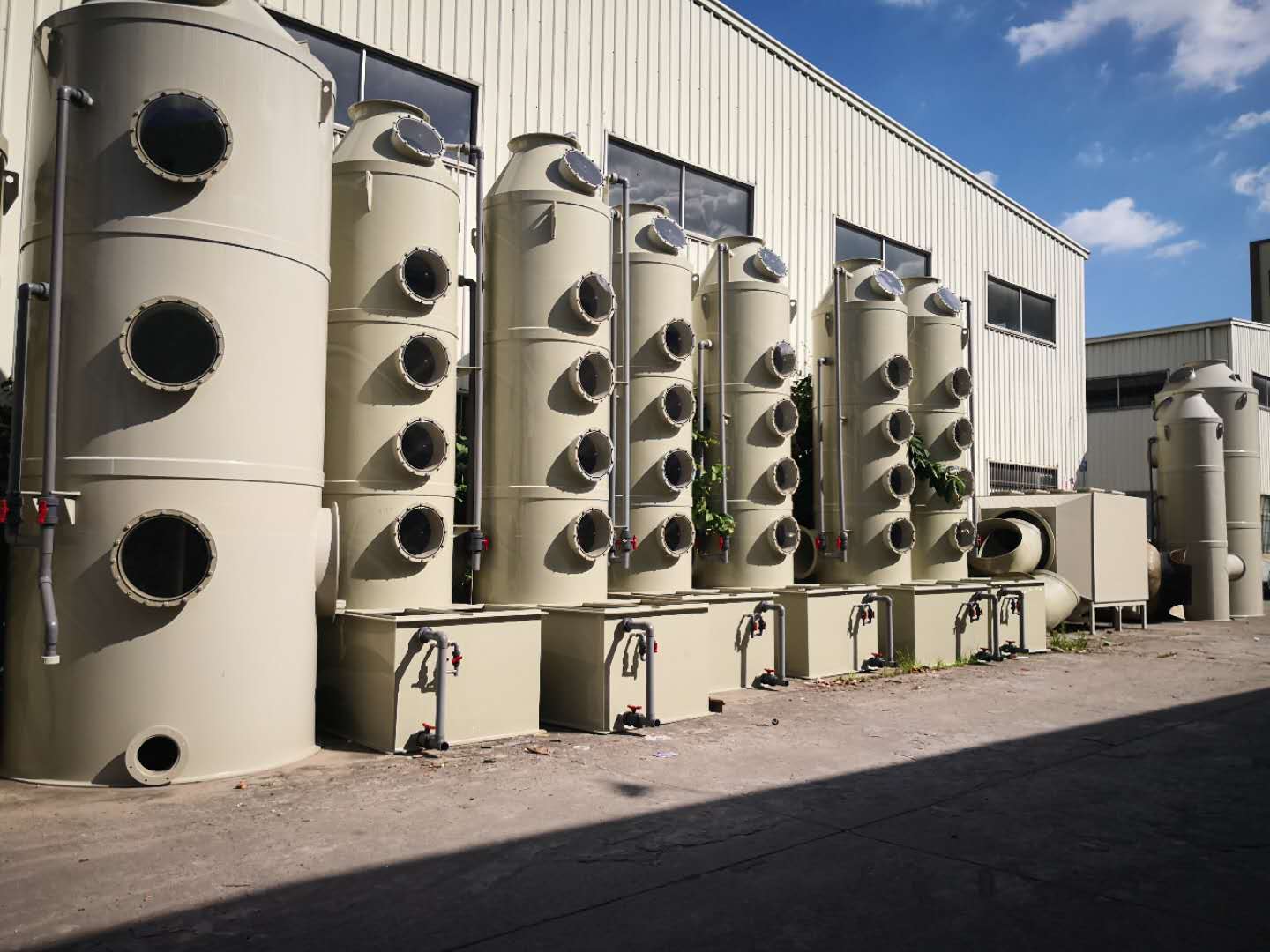
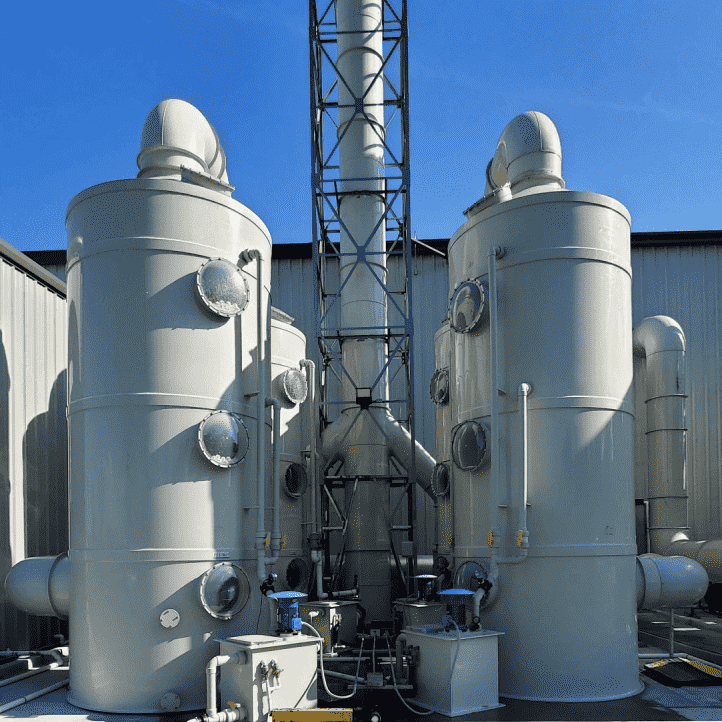
The photographs below show XICHENG wet scrubber equipment and typical exhaust-system arrangements. The exact tower count, access structure, fan, duct routing and footprint are project-specific.
Inside XICHENG: Spray Tower Product Display
This factory product display video gives procurement and engineering teams a closer view of XICHENG spray tower equipment before requesting a wet scrubber proposal.
Engineering and Project Support
XICHENG EP LTD designs and manufactures corrosion-resistant air pollution control equipment in Shenzhen, China. Our team can help you confirm the scrubber configuration, construction material, included equipment, utility requirements, documentation and shipping plan.
Your proposal will link the performance commitment to clearly stated operating conditions and an agreed acceptance method. If your process has several operating cases, send the normal, peak and upset conditions so the system can be sized for the way your plant actually runs.
Wet Scrubber Project FAQ
What information is required for a wet scrubber quotation?
Provide the pollutant names and concentrations, normal and maximum airflow, gas temperature and humidity, required outlet or removal target, operating profile, site constraints, utilities and destination. Mark unknown values clearly; engineering assumptions should be visible in the proposal.
Can a water scrubber system remove every gas without chemicals?
No. Water can work for some highly soluble contaminants, but many applications need controlled pH, an acid or alkaline reagent, an oxidant, or more than one treatment stage. The decision depends on gas chemistry and the required outlet.
How do I choose between PP and FRP construction?
The decision depends on chemical compatibility, temperature, vessel size, structural loading, abrasion, fire requirements and owner standards. The gas and liquid chemistry—including upset and cleaning conditions—must be reviewed before material selection.
Can one scrubber handle several pollutants?
Sometimes. Pollutants that respond to compatible liquid chemistry may be treated in one system. Mixed contaminants can also compete, react with each other or require different pH conditions, so a multi-stage or separate treatment approach may be necessary.
What is included in the wet scrubber price?
The price depends on airflow, chemistry, configuration, material, redundancy, controls, fan, dosing equipment, access structures, documentation and delivery scope. Compare quotations against a written supply boundary rather than the vessel price alone.
How is performance confirmed?
The proposal should identify the design inlet conditions, required outlet or removal basis, operating assumptions, reagent and acceptance method. Site testing and local compliance responsibilities must also be assigned in the contract.
Send One Operating Case to Start
You can begin with one line: pollutant + concentration + maximum airflow + gas temperature + required outlet + destination country. We will use that information to identify the next engineering questions.