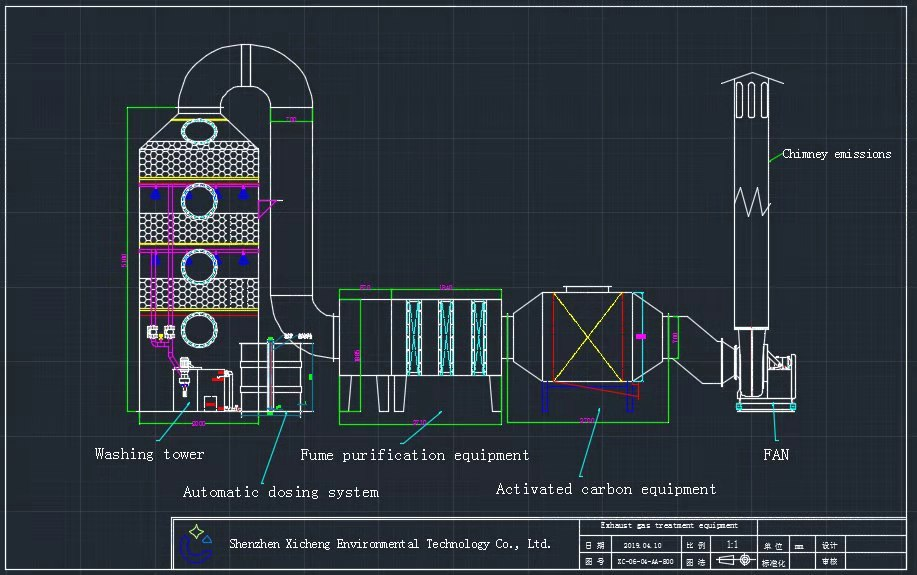
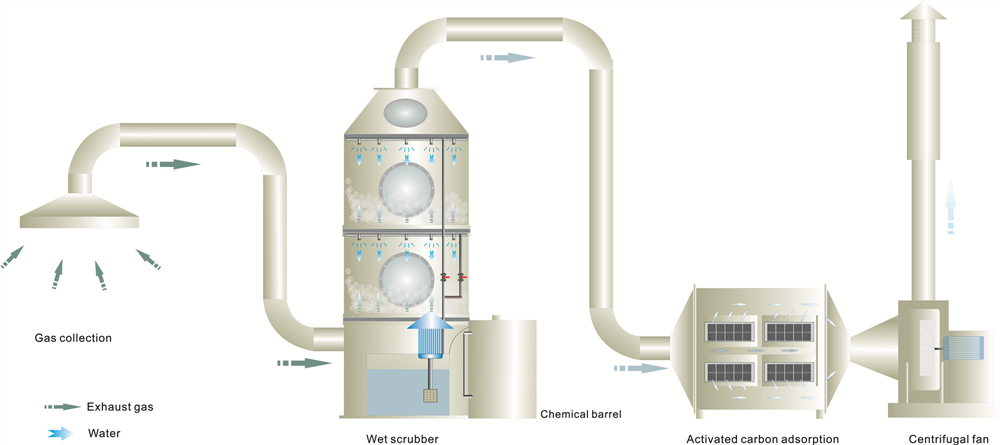
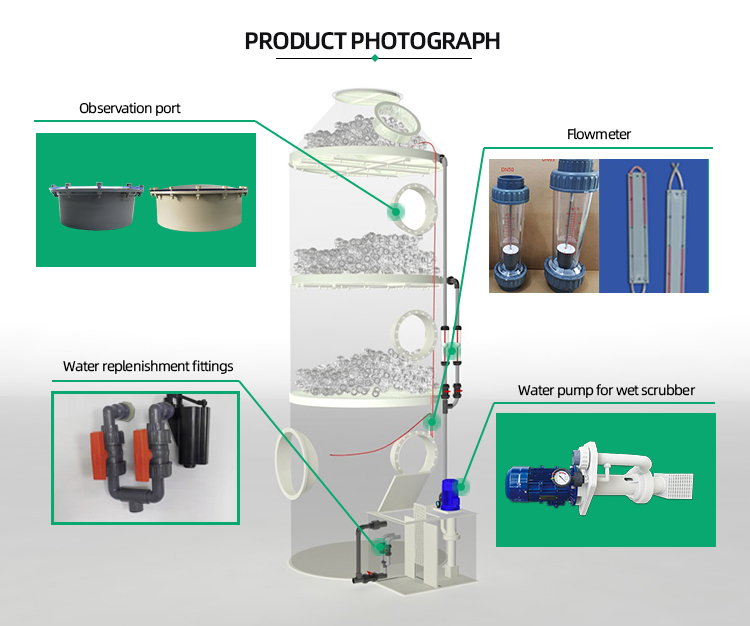
A wet scrubber types selection guide is not a published ISO decision tree, but the variables that decide whether spray tower, packed bed, venturi, or staged service actually works are settled. Dominant duty, pressure-drop budget, gas velocity, liquid-gas ratio, solids tolerance, and chemistry control are the parameters that keep the selection grounded. Follow that logic and the chosen scrubber usually stays online. Skip one of those variables and the plant finds out during maintenance, not at bid review.
Key Takeaways
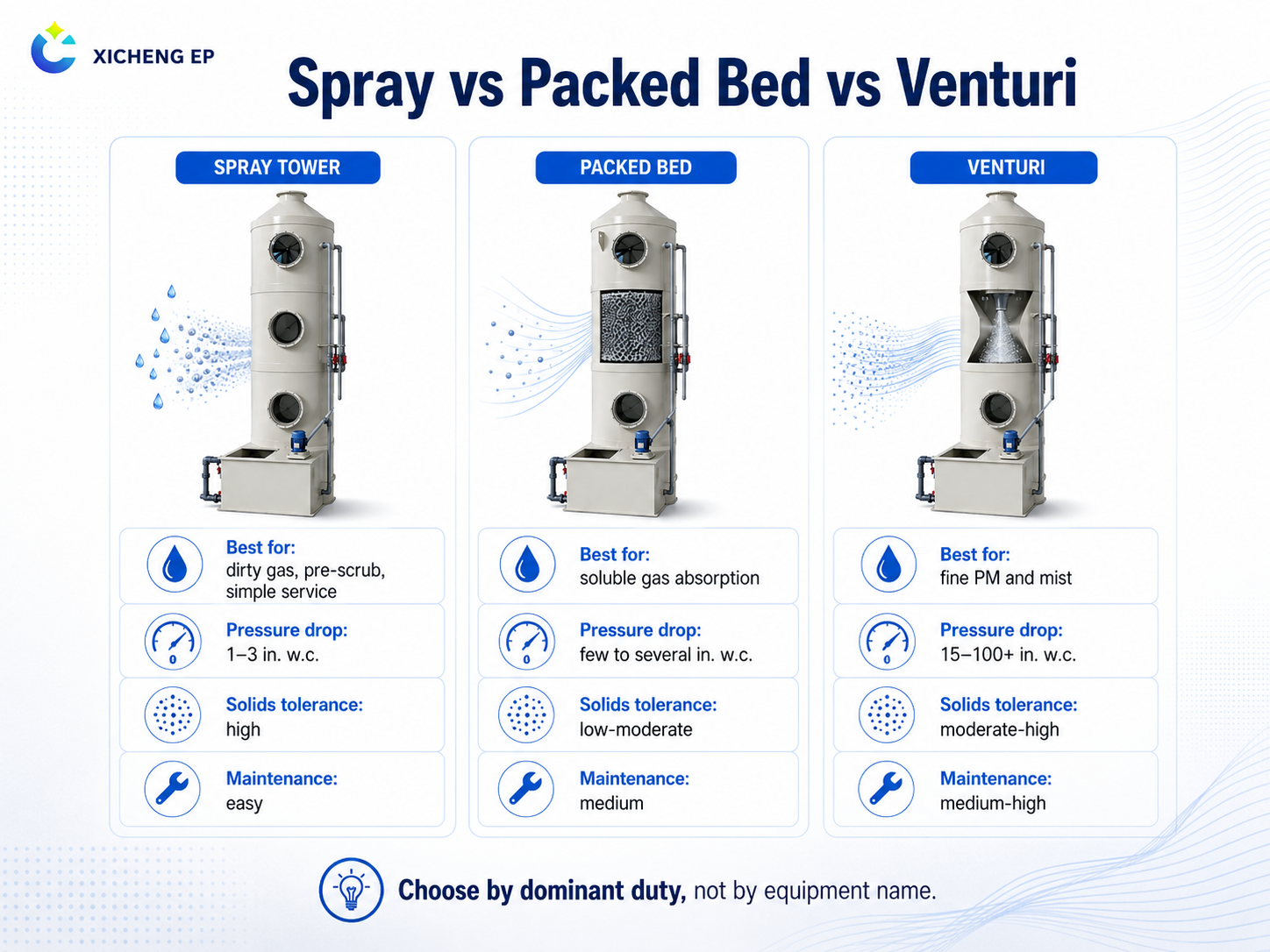
- If the dominant duty is soluble gas absorption, packed beds are usually the first serious option; screening velocity often sits in the few-hundred-fpm range, which is why they deliver stronger gas-liquid contact than an open spray tower at the same airflow.
- If the dominant duty is fine PM capture, venturi scrubbers are usually the right benchmark; throat velocity is often discussed in the high-thousands to tens-of-thousands fpm range, and difficult service can push pressure drop above 100 in. w.c.
- If the stream is dirty, sticky, or pressure-drop-limited, a spray tower can be the better operating choice because simple services often stay around 1-3 in. w.c., but that lower energy design should not be expected to match venturi-level submicron PM capture.
- Ask every supplier to show the sizing basis, not just the model number: `D = sqrt(4Q / (pi V))`, `Liquid flow (gpm) = L/G x Q(acfm) / 1000`, `Fan hp = Q x SP / (6356 x eta)`, and `Pump hp = gpm x head(ft) x SG / (3960 x eta)`.
- If acid gas duty and solids duty are both meaningful, the safer conclusion is usually a staged system rather than a single vessel trying to absorb gas, catch fine particulate, control carryover, and stay clean on the same internals package.
Introduction
Why wet scrubber selection starts with the pollutant, not the equipment name
Wet scrubber types selection should start with the contaminant profile, not with a favorite tower style or a supplier catalog. A project team that starts with “we need a packed bed” or “we always use venturi scrubbers” usually locks itself into the wrong conversation too early. The better starting point is simpler: what is in the gas stream, what outlet limit must be met, and what operating conditions will punish the system after startup.
That framing matters because wet scrubbers solve different jobs through different contact mechanisms. Some designs are better at dissolving or neutralizing gases. Others are better at forcing fine particles into droplets. Some are forgiving when the gas is dirty, hot, or sticky. Others lose performance quickly when solids foul packing or liquid distribution goes uneven. Wet scrubber types selection is therefore a matching exercise between pollutant behavior and equipment behavior.
Gas absorption duty vs particulate control duty
The first split is usually gas absorption duty versus particulate control duty. If the target pollutant is a soluble or reactive gas such as HCl, NH3, or chlorine, the design logic should center on gas-liquid contact area, reagent chemistry, and residence time. If the target is fine particulate matter, mist, or sticky dust, the design logic should center on droplet formation, turbulence, particle capture, and pressure drop. Many projects contain both duties, but one of them usually drives the design more than the other.
This is where weak overview articles stop too early. They list spray towers, packed beds, and venturi scrubbers, then move on. Real buyers need the next sentence: which duty is dominant, which duty is secondary, and what operating penalty follows from that choice. A gas-dominant project can tolerate a different liquid circuit, pressure drop, and maintenance pattern than a fine-PM project.
Why a wrong type still works on paper but fails in operation
The wrong wet scrubber type can still look acceptable in a proposal because many designs can show nominal removal efficiency under narrow assumptions. The problem appears later. A packed bed chosen for a dirty stream may hit fouling and flooding sooner than expected. A spray tower chosen for submicron particulate may miss the real collection target unless the process accepts a lower capture rate. A venturi selected without understanding fan power and recirculation burden may meet the emission target but turn into a high-cost operating headache.
That is why this guide treats wet scrubber types selection as an engineering decision path rather than a glossary. The goal is not to memorize equipment names. The goal is to understand which design fits the pollutant, the process, and the long-run operating reality.
Wet Scrubber Type Selection Principles
Factors related to pollutant properties
The first group of selection factors comes from the pollutant itself. Gas or particulate is the obvious split, but that label is still too broad. Engineers need to ask whether the gas is soluble in water, whether it reacts with alkali or another reagent, whether the particulate is coarse or fine, whether the dust is sticky, and whether the stream carries acid mist, condensable vapor, or solids that will turn into sludge. Wet scrubber types selection gets easier when the contaminant is translated into capture behavior instead of only a chemical name.
Particle size is one of the clearest examples. Fine PM pushes the design toward high-energy contact such as a venturi throat, because the system must create droplet-particle collisions aggressively enough to collect small particles. A soluble acid gas pushes the design toward strong gas-liquid contact area and chemistry control, which is why packed-bed systems appear so often in gas scrubbing service. A stream with high moisture, high temperature, or sticky solids may force the design away from delicate internals even when a packed tower looks good on paper.
Factors related to operating conditions
The second group of factors comes from the operating envelope. Gas flow rate, temperature, pressure drop allowance, solids loading, corrosion level, blowdown handling, and layout constraints all change the answer. A design that works well at modest flow and clean gas may become awkward at very high airflow because vessel size, distributor quality, and recirculation demand grow fast. A design that works at moderate temperature in PP may need FRP, lined steel, or stainless steel once the gas gets hotter or chemically harsher.
Maintenance tolerance also belongs in this group. Some plants can support close control of pH, pump reliability, nozzle inspection, and demister cleaning. Some cannot. Wet scrubber types selection should reflect that reality early. A plant with limited maintenance bandwidth may accept a larger vessel if it reduces plugging risk and shutdown frequency. A site with strict outlet limits but strong maintenance support may accept a more complex staged system because the performance margin is worth it.
Dominant duty vs secondary duty
The most useful decision rule is to state the dominant duty and the secondary duty in one sentence. “Remove HCl, with light particulate present” leads to a different design path than “remove fine particulate, with some soluble gas present.” This one sentence prevents teams from blending two conflicting goals into a vague requirement and then expecting one vessel to behave like two different machines at the same time.
Dominant duty determines which mechanism gets priority. If gas absorption is dominant, the design should prioritize contact area, chemistry control, liquid distribution, and residence time. If particulate capture is dominant, the design should prioritize turbulence, droplet generation, pressure drop, and solids handling. Secondary duty still matters, but it should not quietly take over the system. Wet scrubber types selection becomes more defensible once the team writes down which duty is allowed to drive the design.
When one wet scrubber type is not enough
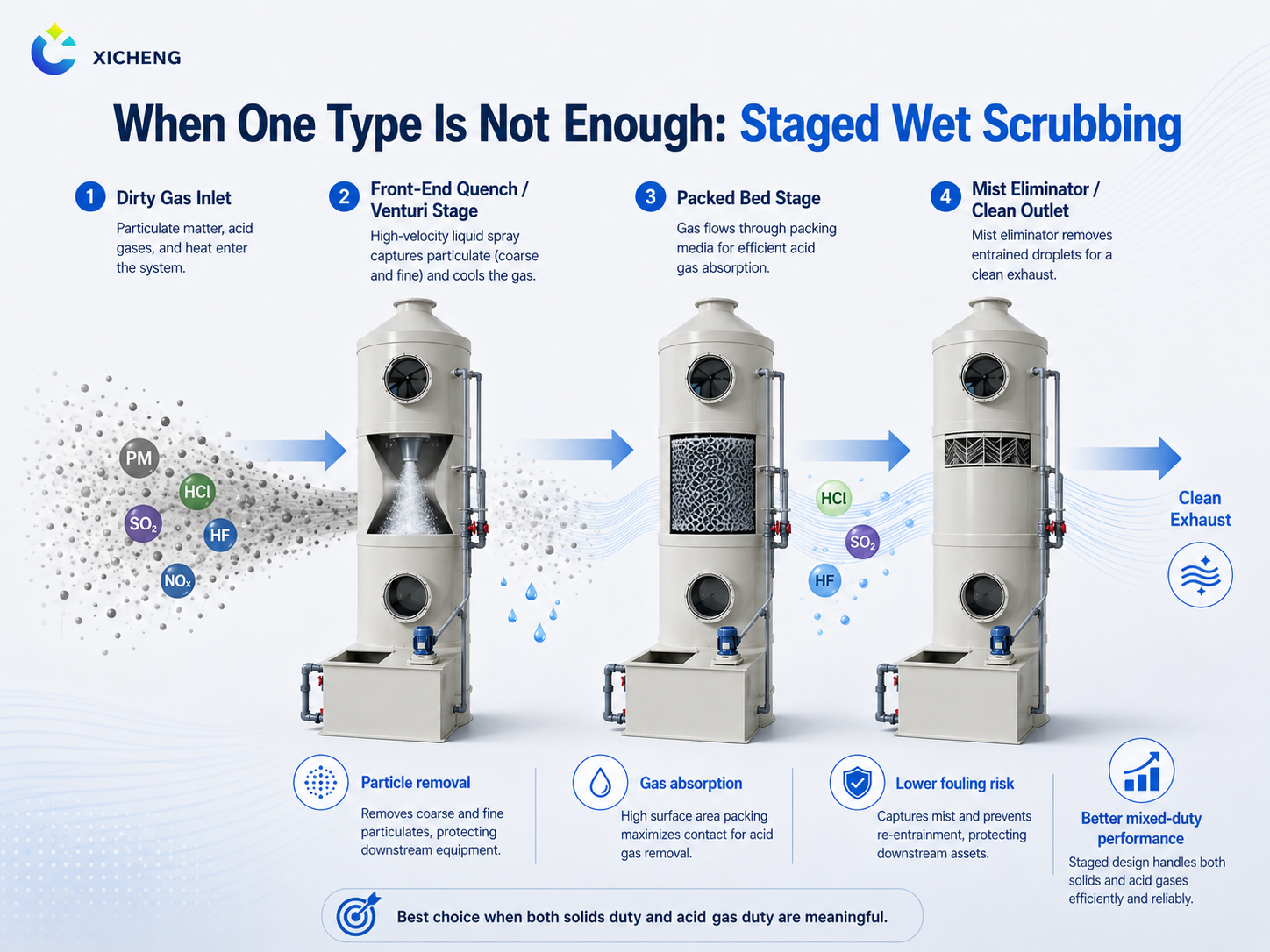
One wet scrubber type is not always enough when the stream combines hard particulate duty with demanding gas absorption duty, or when temperature and solids loading would damage the absorber stage directly. A common solution is a staged arrangement: a quench or venturi up front, then a packed bed or other absorption stage downstream. That arrangement protects the gas-absorption section from fouling while still letting the system meet the gas target.
That does not mean staged systems are always better. They add pumps, controls, footprint, and maintenance points. They should be used because the process needs them, not because the design team wants to hide uncertainty. Good wet scrubber types selection therefore ends with a clear answer to a simple question: can one type meet the target without creating a predictable operating problem, or does the duty require a staged approach from the beginning?
Main Wet Scrubber Types and Where They Fit
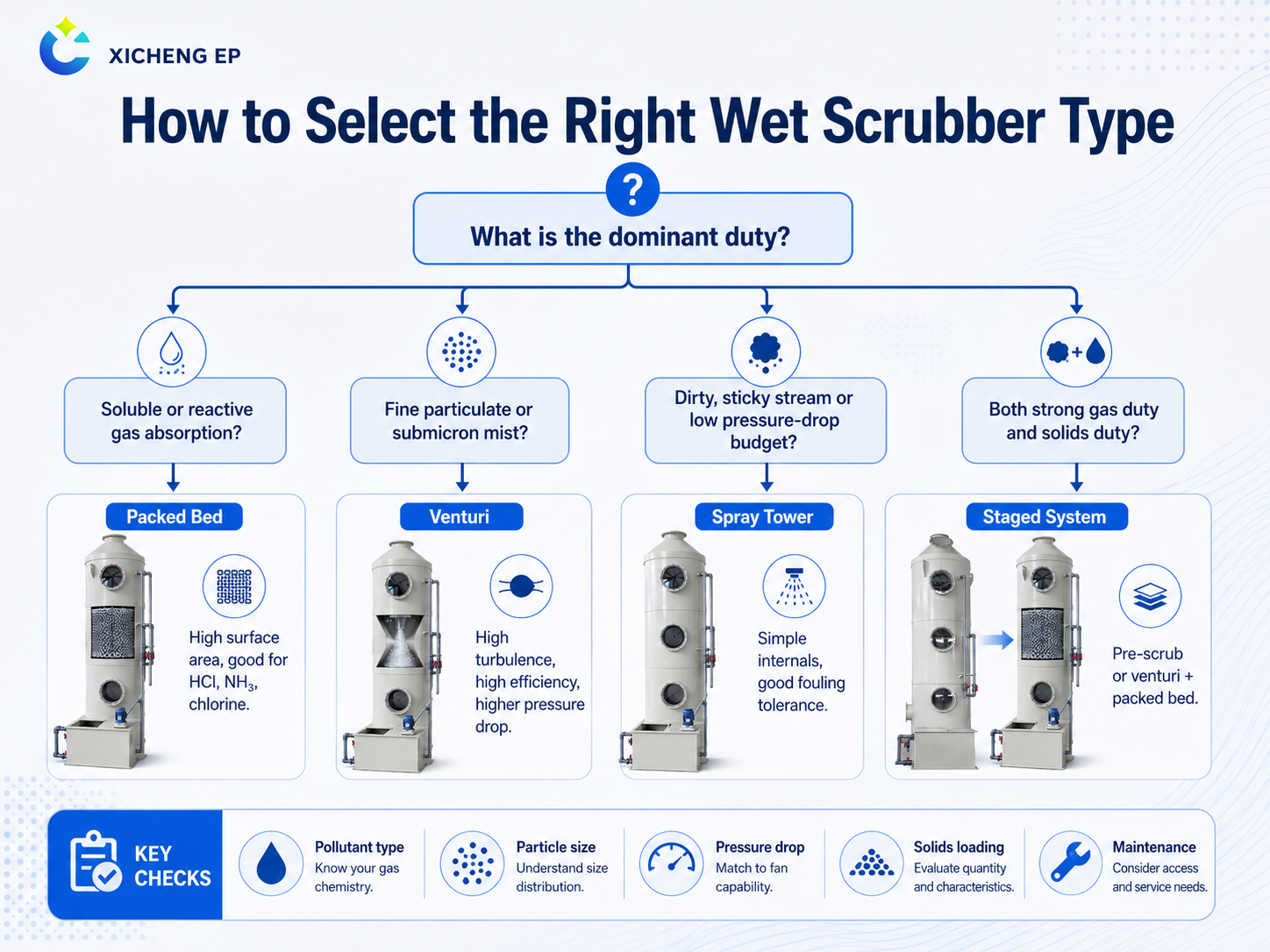
Wet scrubber types selection becomes clearer when each design is treated as a tradeoff between contact intensity, fouling tolerance, pressure drop, and maintenance demand. The four main branches below cover most industrial decisions: spray tower, packed bed, venturi, and crossflow or staged systems. The numeric ranges in this section are practical screening references; final values depend on gas composition, target outlet limit, liquid chemistry, and supplier design basis.
| Type | Dominant fit | Useful screening numbers | Main operating penalty |
|---|---|---|---|
| Spray tower | Dirty gas, quench duty, coarse PM, highly soluble gas | Pressure drop often around 1-3 in. w.c.; usually higher L/G than packed beds | Weak deep fine-PM capture unless the system becomes larger or staged |
| Packed bed | Acid gas, ammonia, odor, reactive gas absorption | Superficial gas velocity often screened in the few-hundred-fpm range | Packing fouling, channeling, scaling, rising pressure drop |
| Venturi | Fine particulate, sticky dust, particulate pretreatment | Throat velocity often runs in the high-thousands to tens-of-thousands fpm; pressure drop may reach 15-100+ in. w.c. | High fan power, slurry wear, higher sludge burden |
| Crossflow / staged | Layout-constrained sites, mixed-duty streams | Stage-specific numbers depend on whether the front end is quench, venturi, spray, or absorption duty | Higher controls count, more pumps, more footprint, more CAPEX |
Spray tower scrubbers
Spray towers are the simplest branch in wet scrubber types selection. They use an open vessel and spray nozzles to bring gas into contact with liquid droplets. Because they do not depend on a packed media bed, spray towers are often more tolerant of dirty gas, sticky residues, corrosive mist, or service where internal plugging risk is a serious concern. Spray towers commonly fit quench duty, bulk gas cooling, highly soluble gas removal, and pre-scrub service where low pressure drop and mechanical forgiveness matter more than maximum mass-transfer intensity.
As a screening reference, spray towers often operate at low gas-side pressure drop, commonly around 1-3 in. w.c. in many simple services. They are more credible for coarse particulate and highly soluble gas duty than for deep fine-PM removal. If the process needs submicron particulate capture or high-efficiency absorption in a compact vessel, the tower may need an impractically high liquid rate or may need to become only the first stage in a larger system. For a product-level view of typical industrial systems, see wet scrubber systems.
Packed bed scrubbers
Packed beds sit on the gas-absorption side of wet scrubber types selection. They use wetted packing media to create gas-liquid surface area, which makes them strong candidates for acid gas, ammonia, odor, and other chemical absorption service. When the gas is reasonably clean and the reagent chemistry is well matched to the pollutant, a packed bed can deliver strong gas removal without forcing the vessel to become excessively large.
Typical packed-bed screening values often place superficial gas velocity in the few-hundred-fpm range and liquid-gas ratio in a lower range than empty spray towers because the packing spreads the liquid into a film. The tradeoff is that the same media that improves absorption also creates a failure point when solids are present. Dust, sticky aerosols, crystallizing salts, or weak liquid distribution can cause channeling, scaling, fouling, and rising pressure drop. A packed bed is therefore a strong choice when gas absorption is the dominant duty and the process can keep the packing clean enough to stay wetted and active.
Venturi scrubbers
Venturi scrubbers belong to the fine-particulate branch. They accelerate gas through a narrowed throat, introduce liquid into a high-turbulence zone, and use droplet-particle collision to capture PM that simpler spray contact may miss. The U.S. EPA venturi scrubber fact sheet describes venturi units as strong options for PM control, with higher removal often tied to higher pressure drop.
Venturi throat velocities are often discussed in the high-thousands to tens-of-thousands fpm range, and pressure drop can range from moderate values to more than 100 in. w.c. in difficult fine-PM applications. That energy penalty is the central tradeoff. Venturi scrubbers can be the right answer for fine PM, sticky dust, wet solids, or a dirty gas stream that would cause problems in dry filtration or packed media. They can also protect a downstream packed bed when the exhaust contains both particulate and soluble gas. They should be chosen when the particulate problem justifies the fan power, erosion risk, recirculation load, and sludge handling.
Crossflow and multi-stage scrubbers
Crossflow scrubbers solve layout and access problems that a tall vertical tower may not handle well. Gas moves horizontally through the contact section while liquid flows downward, which can reduce installed height and improve access in constrained buildings. Crossflow logic is often driven by footprint, maintenance access, and pressure-drop tolerance rather than by a simple efficiency comparison.
Multi-stage systems become necessary when one scrubber type would be forced to do conflicting jobs. A dirty hot stream may need quench first, particulate control second, and gas absorption third. A stream with fine PM plus corrosive gas may need venturi action before a packed bed. This is why wet scrubber types selection should not stop at naming equipment. The real decision is whether one mechanism can carry the duty without creating a predictable operating problem.
Key Design Parameters for Wet Scrubber Selection
| Parameter | Screening formula or range | Why it matters |
|---|---|---|
| Diameter / gas velocity | D = sqrt(4Q / (pi V)); packed beds often screen in the few-hundred-fpm range |
Controls vessel diameter, carryover margin, and distribution quality |
| Liquid-gas ratio | Liquid flow (gpm) = L/G x Q(acfm) / 1000; spray towers usually need higher L/G than packed beds |
Sets pump duty, contact intensity, and wastewater burden |
| Pressure drop | Spray tower often 1-3 in. w.c.; venturi often 15-100+ in. w.c. | Turns directly into fan energy and operating cost |
| Residence time | t = Vactive / Q with consistent units |
Shows whether the proposal has real contact volume or only brochure sizing |
Gas flow and velocity window
Gas flow rate sets the basic scale of the scrubber. It drives vessel diameter, duct sizing, fan selection, liquid distribution, and demister loading. Velocity matters because the same gas volume can behave very differently in different geometries. In wet scrubber types selection, velocity that improves droplet formation in one design may create liquid carryover or maldistribution in another.
A useful first screening formula is D = sqrt(4Q / (pi V)), where D is vessel diameter, Q is gas flow, and V is the selected superficial gas velocity. Use consistent units, such as ft3/min and ft/min. If a packed bed is screened at 400 fpm and a spray tower is screened at a lower velocity for demisting margin, the same airflow can produce very different vessel diameters. Ask for the design velocity basis, not only the nominal airflow.
Liquid-gas ratio and contact intensity
Liquid-gas ratio shows how aggressively the scrubber is trying to create contact between liquid and exhaust gas. Too little liquid can leave dry zones, weak absorption, poor droplet coverage, or unstable temperature control. Too much liquid can raise pump load, increase droplet carryover, expand blowdown volume, and create more wastewater without a proportional gain in removal.
A practical screening formula is Liquid flow (gpm) = L/G x Q(acfm) / 1000, where L/G is expressed as gal/1000 acf. Spray towers may require higher L/G values than packed beds because they lack a wetted packing surface. Packed beds often use lower L/G ranges because the media spreads the liquid into a film. A useful gas scrubber design calculation should explain why the selected liquid rate fits the chosen contact mechanism instead of only reporting a pump flow.
Temperature, chemistry, and solubility
Temperature and chemistry shape both removal performance and mechanical design. Hot gas can increase evaporation, reduce absorption margin for some pollutants, and push material selection toward FRP, lined steel, stainless steel, or a quench stage depending on chemistry and temperature. Reactive gas systems also depend on reagent strength, pH range, and salt formation, not just water contact.
As practical screening references, polypropylene scrubbers are often kept to lower-temperature corrosive service, while FRP can often tolerate a higher temperature window depending on resin system and laminate design. These material limits are not universal; they must be confirmed against the selected plastic, resin, oxidizer level, solvent content, and supplier specification. The U.S. EPA wet scrubber chapter for acid gas makes the same broad point: absorber performance depends heavily on pollutant-solvent behavior.
Pressure drop and energy penalty
Pressure drop is not a small mechanical detail. It becomes fan power every operating hour. Spray towers often appeal because they can keep pressure loss low. Packed beds add resistance through the media and liquid film. Venturi scrubbers may need much higher pressure drop when fine particulate capture is the design driver. The right pressure drop is not the lowest number. It is the pressure drop that earns its cost by solving the actual removal problem.
A common screening formula is Fan hp = Q x SP / (6356 x eta), where Q is airflow in acfm, SP is static pressure in in. w.c., and eta is fan efficiency as a decimal. The formula shows why a venturi operating at a much higher pressure drop can dominate operating cost. The EPA material on particulate wet scrubbers and venturi systems supports the same pattern: stronger PM capture often requires more intense contact and higher energy demand.
Tower geometry, residence time, and layout limits
Tower geometry controls how much time and contact the gas receives. Diameter, active height, bed depth, throat geometry, distributor location, access space, and demister spacing all change performance and serviceability. Residence time matters most when absorption depends on chemistry and mass transfer rather than only particle impaction.
A simple residence-time screen is t = Vactive / Q, where active vessel volume and gas flow use consistent units. This does not replace mass-transfer design, but it helps expose proposals that look compact only because they have very little contact volume. Layout constraints can override ideal geometry, so wet scrubber types selection should check site height, footprint, access clearance, drain routing, and demister pull space before the design is treated as practical.
Solids loading, fouling risk, and wastewater burden
Solids loading often decides whether a strong absorber becomes a maintenance problem. Dust, sticky aerosol, crystallizing salts, and sludge can foul nozzles, packing, demisters, and pump circuits. Once fouling starts, pressure drop, liquid distribution, and removal performance can all change together. Dirty-service streams often need open spray sections, venturi pretreatment, or another particulate-first stage before any packed bed is exposed.
Wet scrubbers transfer contaminants from gas into liquid. They do not make the pollutant disappear. Blowdown rate, sludge handling, dissolved solids, spent reagent, and downstream treatment therefore belong inside the selection discussion. A basic solids balance should estimate captured mass per hour, expected purge rate, and whether the wastewater system can handle suspended solids, dissolved salts, pH, and chemical residuals.
Core Component Design Implications
Nozzle and liquid distribution implications
Nozzles are not minor accessories in wet scrubber types selection. They define droplet pattern, coverage, liquid distribution quality, and plugging risk. In a spray tower, nozzle selection is central because the droplet field is the contact zone. In a packed bed, nozzle and distributor quality determine whether the packing stays active across the full cross section or develops weak areas. In a venturi, the liquid introduction method affects atomization quality and overall contact behavior.
The same nozzle that works in clean recirculation service may fail quickly in a scaling or solids-bearing loop. That is why liquid quality, strainers, inspection access, and wash strategy should sit in the same decision frame as nozzle pattern. A tower selected without considering liquid distribution hardware is not really selected yet.
Packing, mist eliminator, and internals implications
Packing media, support grids, distributors, and mist eliminators shape the difference between nameplate performance and real operating performance. Packing creates surface area, but it also creates fouling surface. Support hardware must carry wet load and keep gas distribution stable. Mist eliminators are not decorative end pieces; they keep droplet carryover from turning a good absorber into a visible stack problem or a corrosion issue downstream.
The EPA wet scrubber chapter for particulate matter reinforces the importance of contact mechanism and separation behavior in particulate control. In practice, that means a team should ask how the internals package behaves after months of solids exposure, not only how it behaves in clean startup conditions. Wet scrubber types selection improves when demister cleaning, packing access, and support durability are treated as design criteria rather than spare-parts topics.
Material selection: PP, FRP, stainless steel, and lined steel
Material choice decides service life as much as removal performance does. PP is attractive in many corrosive, lower-temperature services because it resists a wide range of acids and alkalis and is practical to fabricate. FRP becomes attractive where larger vessel size, outdoor durability, or structural stiffness matter. Stainless steel may work in some hot or solvent-bearing services, but it can become the wrong answer quickly in chloride-rich or aggressive acid environments. Lined steel offers shell strength plus process-side protection, but it introduces lining quality and repair questions that have to be taken seriously.
Material logic should run through the full wet path: shell, internals, nozzles, supports, pumps, seals, and drain hardware. Wet scrubber types selection is incomplete if the shell material is chosen well but the demister, distributor, or pump wetted parts are chemically mismatched. Plants rarely remember the tower shell when a system goes down. They remember the first weak component that failed.
Recirculation, Pump, and Chemical Control Considerations
Pump and recirculation requirements by scrubber type
The recirculation pump is part of wet scrubber types selection, not a utility detail to size after the vessel is chosen. Spray towers need enough flow to maintain droplet coverage and wall wetting. Packed beds need stable distribution over the packing and enough head to feed distributors at the required elevation. Venturi systems can create harder liquid service because captured solids, turbulence, and slurry handling may punish pumps, seals, and piping.
A useful pump screen is Pump hp = gpm x head(ft) x SG / (3960 x eta), where SG is liquid specific gravity and eta is pump efficiency as a decimal. This formula shows why a scrubber with a high recirculation rate and high spray pressure can become expensive even if the gas-side pressure drop is modest. A supplier comparison should show recirculation flow, pump head, nozzle pressure, liquid density, and solids tolerance beside the removal target.
Chemical dosing and pH control implications
Chemical dosing becomes central when gas removal depends on reaction. Acid gases often require alkali control, while ammonia and some other services may require an acid reagent or a different chemistry plan. The vessel cannot compensate for a liquid loop that loses pH control under peak load. If the reagent circuit is slow, poorly mixed, or under-instrumented, gas removal can swing even when the tower itself is correctly sized.
A caustic scrubber system, for example, needs more than a tank of sodium hydroxide. It needs dosing logic, pH measurement, recirculation stability, blowdown management, and enough margin for inlet concentration changes. Screening calculations should estimate reagent demand from pollutant molar load first, then add a safety factor that the supplier can justify. Over-dosing can raise chemical cost and contribute to salt or scaling issues; under-dosing can reduce absorption and compliance margin.
What these choices do to operating stability
Operating stability depends on the liquid circuit staying within its useful range. Pump flow, reagent strength, pH, conductivity, suspended solids, and blowdown rate all interact. If operators restrict blowdown too far to save water, dissolved solids can climb and increase scaling risk. If nozzles start plugging, distribution weakens. If pump seals are exposed to abrasive slurry, reliability falls. These are not side problems; they are part of how the scrubber performs.
Wet scrubber types selection should therefore end with an operating question: what must stay controlled every day for this system to keep meeting its target? Strong proposals usually define pump duty, pH range, conductivity or TDS monitoring logic, blowdown trigger, strainer access, and nozzle inspection method. If those controls are vague, the design may be technically possible but operationally fragile.
Specialty Variants That May Enter the Selection
Impingement and multi-vane particulate scrubbers
Impingement and multi-vane particulate scrubbers show up in competitor material because they solve a real niche between simple spray contact and classic high-energy venturi service. They can be useful where particulate capture is needed but the plant wants a different balance between pressure drop, moisture tolerance, footprint, and maintenance pattern. Multi-vane systems, in particular, are often discussed where wet particulate removal must stay efficient without defaulting immediately to the highest-energy design.
These variants should be treated as branch options inside wet scrubber types selection, not as universal upgrades. They matter when the particulate duty, temperature, or moisture profile fits their capture pattern. They matter less when gas absorption chemistry is the real design driver.
Cyclone spray chambers and orifice scrubbers
Cyclone spray chambers and orifice scrubbers sit in the same “specialty geometry” category. They are usually discussed when the process favors a specific droplet formation pattern, separation path, or vessel layout that differs from a standard spray tower or venturi arrangement. Their value is not that they are exotic. Their value is that they may fit a narrow process window more cleanly than the default geometry.
That said, they should not distract the buyer from the main decision path. Most projects still need to answer the same basic question first: is the dominant duty gas absorption, particulate control, or a staged mix of both? Specialty geometries refine that answer. They do not replace it.
When a specialty variant belongs in vendor discussions
A specialty variant belongs in supplier discussions when the plant already knows what process feature is making standard type choices awkward. That may be sticky dust, high moisture, limited footprint, temperature swings, or a need to control particulate without accepting the full operating penalty of a classic venturi approach. Wet scrubber types selection gets stronger when specialty variants are raised as a response to a process constraint, not as a marketing detour.
Cost and Operating Tradeoffs
| Type | Pressure-drop screen | Operating cost pattern | Economic logic |
|---|---|---|---|
| Spray tower | Often around 1-3 in. w.c. | Lower fan power, but water rate and recirculation still matter | Makes sense when dirty gas and low pressure drop matter more than compact high-intensity capture |
| Packed bed | Usually a few to several in. w.c., rising with fouling | Moderate fan load, chemistry-sensitive OPEX, internals cleaning risk | Wins when gas absorption value outweighs media-fouling risk |
| Venturi | Often 15-100+ in. w.c. | High fan power, high slurry handling burden, more wear parts | Justified when fine particulate capture is the duty that drives compliance |
| Staged system | Sum of stage losses | Higher CAPEX and controls count, but lower risk of forcing one vessel to do two jobs badly | Best when one-stage compromise would create predictable downtime or outlet risk |
Capital cost vs operating cost
Capital cost answers only the first purchase question. Operating cost answers whether the chosen type remains acceptable after a year of production. Wet scrubber types selection should compare vessel cost, internals, pumps, controls, installation, fan power, reagent use, water demand, demister maintenance, sludge handling, and downtime. A cheaper vessel can become the more expensive option if it pushes avoidable cost into daily operation.
The reverse is also true. A higher-cost packed bed, crossflow unit, or staged system can be justified when it lowers chemical use, protects internals, reduces downtime, or gives better control margin. The useful comparison is total cost of ownership, not the lowest equipment invoice.
Pressure drop, fan power, pump load, and chemistry cost
Energy and chemistry costs are tied to the contact method. A quick screen can estimate fan power with Fan hp = Q x SP / (6356 x eta). A second screen can estimate pump power with Pump hp = gpm x head(ft) x SG / (3960 x eta). These two formulas help explain why a design with low vessel cost can still have high utility cost if it depends on high pressure drop or heavy liquid circulation.
Venturi systems may justify their energy demand when fine particulate is the real duty. Spray towers may save fan power but require more liquid contact or circulation for some duties. Packed beds can be efficient for gas absorption but create maintenance cost when solids are not controlled. Wet scrubber types selection is stronger when the energy, water, chemistry, and maintenance assumptions are visible before purchase.
Downtime, maintenance, and wastewater handling
Maintenance burden is where lifecycle cost becomes visible to the plant. Nozzle cleaning, packing washout, demister replacement, pump seal service, sludge removal, and blowdown treatment can cost more than the proposal suggests. Systems that foul faster or require close chemistry control may meet emission targets yet still lose favor with operators because the downtime pattern is too punishing.
Wastewater handling belongs in the same category. Wet scrubbers move pollutants into liquid, which means blowdown chemistry, suspended solids, salts, sludge, and disposal route all affect operating cost. A plant should estimate captured contaminant mass, purge volume, neutralization needs, and disposal route before treating the scrubber purchase as an air-side decision only.
What a useful supplier quotation should include
A useful quotation should show the basis of selection, not just a vessel model and a price. At minimum, it should identify airflow, inlet load, target outlet load, dominant duty, expected pressure drop, liquid recirculation rate, pump head, chemistry assumptions, material specification, demister type, blowdown expectation, and maintenance-sensitive internals. If the quote cannot explain why this wet scrubber type was selected instead of another type, it is not yet a complete selection document.
Common Wet Scrubber Selection Mistakes
Selecting by pollutant name only
A pollutant name is not enough detail to support wet scrubber types selection. “Acid gas” does not tell you solubility, reagent demand, temperature, peak concentration, or salt behavior. “Dust” does not tell you particle size, stickiness, explosibility, or whether the solids will foul packing. Teams that stop at the label often choose a scrubber family that sounds correct but is poorly matched to the process behavior.
Ignoring dust before a packed bed
Packed beds are strong gas absorbers, but they are not forgiving of every solids burden. Dust, sticky aerosol, or salt-forming service can make media behave like an unintended filter. The result is often rising pressure drop, channeling, and uneven wetting. If solids are significant, the design should test whether particulate control or open pre-scrub duty is needed before the packed bed.
Underestimating pressure drop and recirculation load
Pressure drop and liquid circulation become operating cost every hour the process runs. A high-energy design can be justified when fine PM capture requires it, but it should not be chosen without checking fan power, pump duty, and wastewater load. A compact design can still be expensive if it depends on narrow hydraulic or chemistry margins to stay compliant.
Treating the mist eliminator as an afterthought
Mist eliminators are part of the removal system, not a final accessory. Poor demisting can cause visible carryover, corrosion, deposits, and apparent emission problems even when the contact section is working. Wet scrubber types selection should include demister style, face velocity, cleaning access, and material compatibility before the equipment choice is considered complete.
Frequently Asked Questions
What is the best type of wet scrubber?
There is no single best type for every application. Packed bed scrubbers are usually stronger for soluble gas absorption. Venturi scrubbers are usually stronger for fine particulate capture. Spray towers are often better when the plant values low pressure drop, simple internals, dirty-service tolerance, or pre-scrub duty. The best answer depends on the dominant pollutant duty and the operating limits around it.
Which wet scrubber type is best for acid gas?
A packed bed scrubber is often the first serious option for acid gas because it provides strong gas-liquid contact area and works well with controlled reagent chemistry. Spray towers can fit highly soluble or less demanding gas duties. Staged systems may be needed when acid gas removal is combined with meaningful dust, mist, or high-temperature pretreatment.
Which wet scrubber type is best for fine particles?
A venturi scrubber is usually the strongest standard wet option for fine particles because it uses high turbulence and droplet formation to improve particle capture. As a screening reference, venturi pressure drop can range from moderate levels to more than 100 in. w.c. in difficult fine-PM service. The tradeoff is higher fan energy, more hydraulic burden, erosion risk, and more sludge handling than simpler tower types.
Can one wet scrubber remove both gas and dust?
Yes, one wet scrubber can remove both gas and dust when the duty is moderate or when one pollutant is easy to capture. For stricter mixed-duty service, a staged system often works better: one stage handles particulate or cooling, and another stage handles gas absorption. This keeps each contact mechanism closer to the job it performs best.
How do I choose between PP and FRP for a wet scrubber?
Choose based on chemistry, temperature, vessel size, structural demand, UV exposure, and fabrication method. PP is attractive in many lower-temperature corrosive duties. FRP is often attractive for larger outdoor equipment or where stiffness and structural reinforcement matter. Final material selection should include nozzles, packing supports, demisters, seals, pump wetted parts, and drain hardware, not only the shell.
What should be checked first in wet scrubber types selection?
The first check in wet scrubber types selection is the duty split: gas absorption or particulate control, plus particle size, solubility, chemistry, temperature, and solids loading. Once that profile is clear, the team can decide whether the process points toward a spray tower, packed bed, venturi, crossflow unit, or staged system.
Sources
Technical references used
Explore Each Scrubber Type in Detail
For in-depth coverage of specific scrubber types, design parameters, and comparisons referenced in this selection guide, see the dedicated articles below:
- Packed Bed Scrubber Working Principle and Design — detailed working principle, packing types, design limits
- Spray Tower Scrubber: Design, Operation, and Applications — open-tower design, H/D ratio, nozzle selection
- How Does a Wet Scrubber Work? Types, Components, and Industrial Uses — foundational guide to wet scrubbing
- Crossflow Scrubber Design: Horizontal Uses, Layouts, and Limits — horizontal configuration, space-constrained installations
- Wet Scrubber vs Dry Scrubber: Uses, Costs, and Limits — head-to-head comparison for technology selection
- Venturi Scrubber vs Wet Scrubber: Fine PM and Best Fit — Venturi sizing versus conventional packed/spray towers
- Packed Bed vs Venturi Scrubber: Gas, PM, and Energy Tradeoffs — decision framework for the packed-versus-venturi choice
- Wet Scrubber Manufacturers: How to Choose a Reliable Supplier — fabricator evaluation criteria and procurement checklist
Conclusion
What the selection logic means in practice
A wet scrubber is the right answer only when the dominant duty, solids burden, and pressure-drop budget all point in the same direction. Packed beds earn their place when gas absorption dominates and the gas is clean enough to protect the media. Venturi scrubbers earn their place when fine PM capture justifies the fan power and sludge burden. Spray towers earn their place when the gas is dirty, the pressure-drop budget is tight, or the plant needs a simpler contact section that operators can keep running. The velocity windows, L/G screens, fan and pump formulas, and staging rules in this guide are not decorative numbers. They are the parameters that keep a selection review grounded in operating reality.
What to send before asking for a quotation
Before asking for pricing, send airflow, temperature, pollutant list, concentration range, particle-size information, solids loading, target outlet limit, reagent preference, utilities, and layout constraints. That is the difference between getting a real engineering proposal and getting a model number with a guessed efficiency. For specifications and pricing on systems built to your gas flow and contaminant profile, browse our wet scrubber product catalog or contact our engineering team with your design parameters.
Written by Corbin, Applications Engineer at XICHENG EP Ltd. – 10+ years designing and commissioning industrial exhaust gas treatment systems across 30+ countries and 500+ installations. Corbin has sized scrubbers for chemical plants, electroplating lines, wastewater treatment facilities, and semiconductor fabs, and has seen what happens when a packing selection goes wrong during commissioning.
Scrubber Design Calculation: Guide to All 4 Wet Scrubber Types