
A packed bed scrubber removes pollutants through gas-liquid contact on the wetted surface of the packing media. The packing geometry, material, and size determine whether that contact is efficient or wasted. Selecting the right packing is not a commodity decision — it is the second most critical specification after the shell material, and getting it wrong requires a full shutdown to correct.
This guide covers packing geometries and their performance data, a five-step material selection process, HETP-based bed height calculation with a worked example, common selection mistakes that cost $8,000-45,000 to fix, maintenance signals that tell you when packing needs replacement, and the support grid and liquid distributor requirements that prevent premature failure. The focus is on the packing media itself — not general scrubber sizing, system-level cost analysis, or scrubber troubleshooting.
For specifications and pricing, contact XICHENG EP or browse our packing media product range.
Key Takeaways
- Pall rings are the default choice for acid-gas scrubbing, but structured packing cuts required bed height by 25-40%. A 25 mm Pall ring offers 209 m²/m³ specific surface area with 91% void fraction, while structured corrugated sheet packing (250 m²/m³) achieves HETP of 0.3-0.5 m versus 0.45-0.65 m for Pall rings. If your tower height is constrained, structured packing lets you fit more theoretical stages into the same physical space — but at 1.8-3x the cost.
- PP packing in HCl service lasts 10-15 years. SS316 in the same service fails within 2-5 years. Specifying metal packing for chloride-containing gas streams is the single most expensive material mistake you can make — the dissolved iron from corroding rings contaminates the scrubbing liquor and forces an early re-bedding. PP handles HCl, H₂SO₄, and NaOH across pH 0-14 at temperatures up to 80°C.
- A 20% rise in differential pressure at constant fan speed means your packing is failing — start planning replacement. Packing failure is gradual. You will see pressure drop climb and outlet concentration drift weeks before visible fragments appear in the sump. Monthly pressure drop tracking costs nothing and prevents the production losses from an unexpected scrubber shutdown.
- Packing size matters more than most specifiers think: 50 mm rings resist fouling 3-6x longer than 16 mm in particulate-laden gas. Choosing 16 mm Pall rings for maximum surface area ignores the real-world fouling rate. In electroplating or batch chemical processing exhaust, Tellerette packing at 92-94% void fraction maintains stable pressure drop 2-3 times longer between cleanings than Pall rings of equivalent surface area.
- Incorrect liquid distribution causes 20-40% efficiency loss even with the right packing installed. A quality liquid distributor costs $1,200-3,500 more than a basic one. That is far less than the cost of re-bedding a tower where dry zones have allowed untreated gas to bypass the wetted packing bed.
What Is Scrubber Packing Media?
Scrubber packing media is the material placed inside a packed column or scrubber tower to create a large wetted surface area for gas-liquid contact. The packing forces the gas stream into repeated contact with the scrubbing liquid, allowing pollutants to transfer from the gas phase into the liquid phase through absorption or chemical reaction. Without packing, a scrubber tower would be an empty vessel with minimal contact between gas and liquid — removal efficiency would drop below 30% regardless of chemical dosage.
The packing geometry, material, and configuration determine three things: how much surface area is available for mass transfer, how much resistance the gas flow encounters (pressure drop), and how uniformly the liquid spreads across the bed. A packing selection decision made during the design phase locks in the scrubber’s performance for the next 10-15 years. Changing the packing later requires a full shutdown, draining, and re-bedding — typically $8,000-22,000 in labor and lost production time for a mid-size scrubber.
For a detailed breakdown of how scrubber internals interact with the overall system design, see our gas scrubber design calculation guide.
Types of Scrubber Packing Media: Random vs Structured
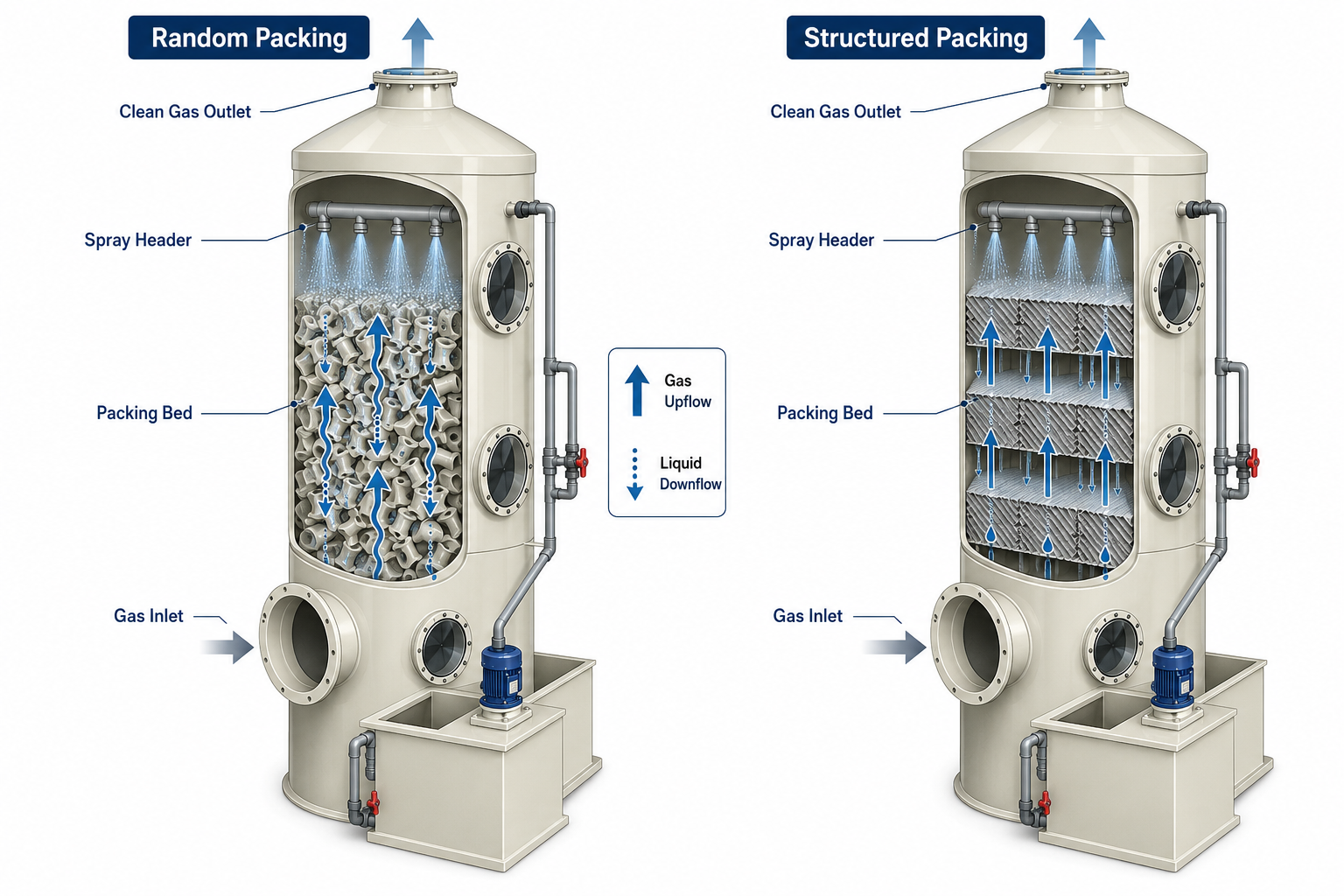
Scrubber packing media falls into two categories: random packing and structured packing. The choice between them affects your tower’s height, pressure drop, turndown capability, and maintenance frequency. Each category includes several geometry variants with different performance profiles.
Random Packing
Random packing consists of individual pieces dumped into the tower to form a packed bed. The pieces settle into random orientations, creating irregular flow paths for gas and liquid. This category is the most common choice for acid-gas scrubbing because of its lower cost, simpler installation, and proven track record across thousands of installations.
Pall Rings. The most widely specified random packing for scrubbers. A Pall ring is a cylinder with internal ribs and rectangular windows cut into the wall. The windows create additional liquid drip points and reduce pressure drop compared to the older Raschig ring design. Standard PP Pall rings range from 16 mm to 90 mm nominal size. The 25 mm size provides 209 m²/m³ specific surface area with 91% void fraction, making it the default choice for most HCl, SO₂, and H₂S scrubbing applications. The 50 mm size (100 m²/m³, 95% void) is preferred when the gas stream carries particulate matter, since the larger void channels resist plugging.
Raschig Rings. The original random packing design — simple hollow cylinders without internal features. They offer lower mass transfer efficiency and 40-60% higher pressure drop than Pall rings of the same size, which is why most modern scrubber designs use Pall rings instead. Raschig rings remain in use for high-temperature ceramic applications where the simpler shape provides better mechanical strength.
Saddle Rings (Berl and Intalox). Saddle-shaped packing pieces with curved surfaces that prevent nesting — a common problem with cylindrical packing where pieces settle into tight configurations that block liquid flow. The curved geometry of Intalox saddles provides 15-25% better liquid spreading than Pall rings at the same nominal surface area. They are specified for polishing scrubbers where outlet concentration must stay below 5 mg/Nm³.
Tri-Packs. Spherical random packing with multiple internal ribs and open windows. The spherical shape maintains consistent void fraction throughout the bed, unlike cylindrical packing that settles and compacts over time. PP Tri-Packs in 25 mm size offer 185 m²/m³ surface area with 90% void fraction. They are used in retrofit projects where fan capacity is limited, because they deliver the lowest pressure drop per unit of mass transfer among random packings.
Tellerettes (Rosette Packing). Multi-ring rosette shapes with very high void fraction (92-94%) and moderate surface area (125-180 m²/m³). The open structure resists fouling from particulate-laden gas streams better than any other random packing geometry. In electroplating or batch chemical processing applications with intermittent particulate spikes, Tellerette packing maintains stable pressure drop 2-3 times longer between cleanings than Pall rings of equivalent surface area.
Structured Packing
Structured packing consists of corrugated sheets or knitted wire layers assembled into precise geometric arrangements. The gas and liquid follow defined paths through the packing, eliminating the random flow variations that occur in dumped beds. Structured packing achieves HETP of 0.3-0.5 m — a 25-40% improvement over random packing — while maintaining lower pressure drop per theoretical stage.
The trade-off is higher initial cost (typically 1.8-3x the cost of random packing for equivalent tower volume) and greater sensitivity to fouling. Structured packing is the preferred choice for clean gas applications where tower height is constrained, such as retrofitting taller scrubbers into existing buildings or replacing tray columns without increasing column height.
For a direct comparison of packed scrubber types in different applications, see our packed bed scrubber design guide.
Scrubber Packing Media Selection: 5-Step Process
Selecting the right packing media for a scrubber follows a five-step process that starts with the process fluid and ends with the support grid design. Skipping any step increases the risk of a selection error that requires a full shutdown to fix.
Step 1: Identify Process Fluid and Chemical Compatibility
Confirm that the packing material is compatible with both the gas being scrubbed and the scrubbing liquid. PP handles most acids and alkalis across pH 0-14 at temperatures up to 80°C. For hot oxidizing acids above 80°C (such as concentrated H₂SO₄ at 110°C), PVDF or ceramic is required. For HF service, ceramic packing dissolves — only PP or PVDF should be used, and PVDF is preferred above 70°C.
Step 2: Choose Packing Size Based on Tower Diameter
The packing size must not exceed one-eighth of the column diameter. For a 600 mm diameter scrubber, the maximum packing size is 75 mm, making 50 mm Pall rings the largest practical choice. For most industrial scrubbers with diameters of 1.2-3 m, 25 mm and 50 mm sizes are the most common. Smaller packing (16-25 mm) provides more surface area and better mass transfer efficiency but creates higher pressure drop and is more prone to fouling.
Step 3: Evaluate Pressure Drop Constraints
If the scrubber fan has limited static pressure capacity, the packing must operate within that envelope. Larger ring sizes and plastic materials generate lower pressure drop per meter of bed height. For a typical packed bed operating at 70% of flood, pressure drop ranges from 0.5-1.2 inches of water column per foot of bed height, depending on packing type and size. Ask your packing supplier for pressure drop curves at your design gas velocity rather than relying on generic values.
Step 4: Assess Fouling Tendency
Gas streams carrying particulate matter require larger packing sizes to prevent bed plugging. For streams with more than 50 mg/Nm³ of particulate, use 50 mm or larger packing. Tellerette or Tri-Pack geometries resist fouling better than Pall rings in dirty service because their more open structure creates fewer dead zones where solids accumulate.
Step 5: Specify Support Grid and Liquid Distributor
The packing support grid must have at least 70% open area to avoid restricting gas flow. The liquid distributor must deliver uniform irrigation across the full tower cross-section to prevent dry zones. The design of these components is as important as the packing itself. For guidance on the full design methodology from column diameter to bed height, see our packed bed scrubber design calculation guide.
Packing Material Comparison: PP vs Metal vs Ceramic
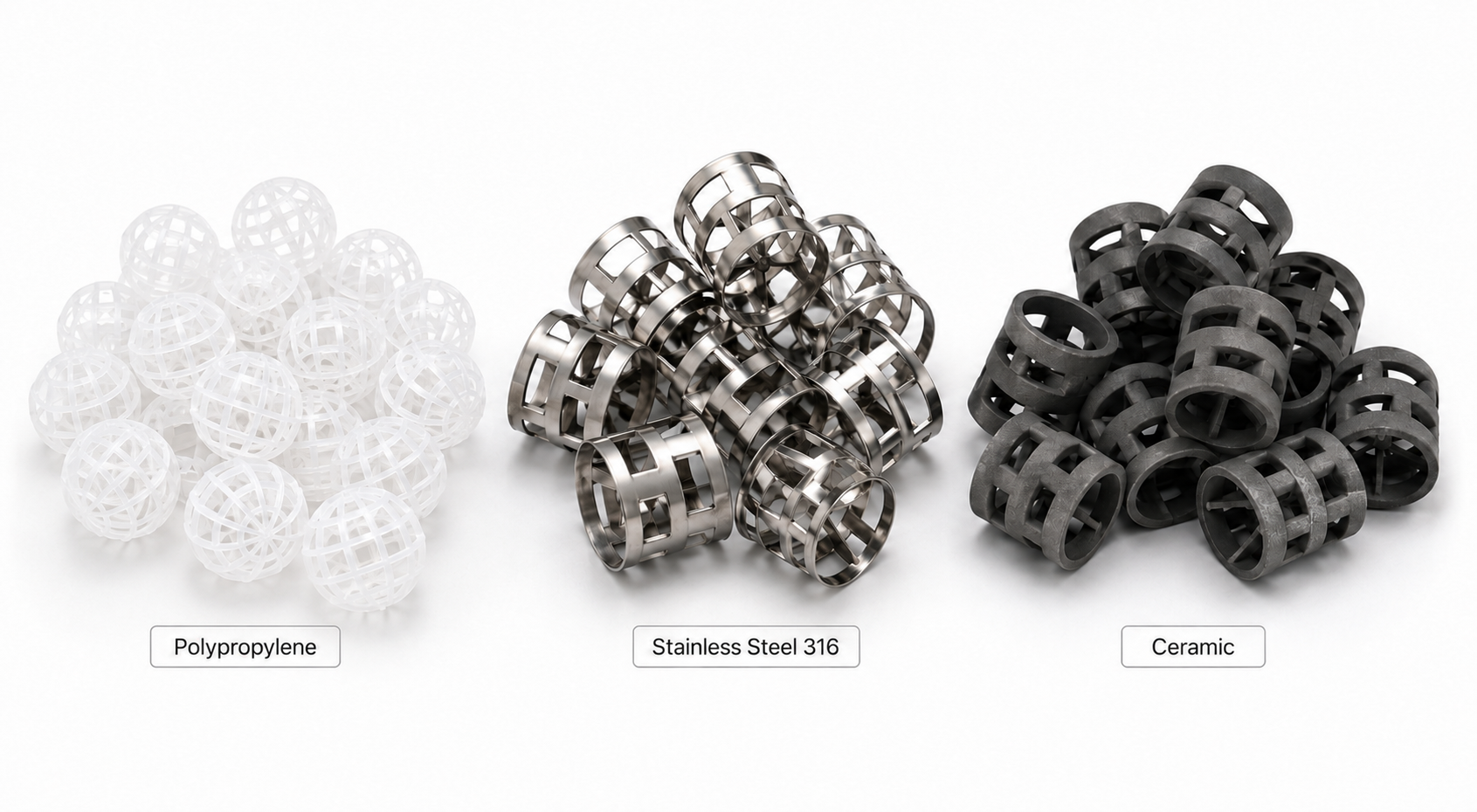
The material you choose for your packing rings determines the service temperature range, chemical resistance, and replacement interval. Each material group has distinct advantages and limits that go beyond simple corrosion resistance tables.
| Parameter | Polypropylene (PP) | Stainless Steel (304/316) | Ceramic (Alumina) |
|---|---|---|---|
| Temperature range | Up to 80°C (PP), 120°C (PVDF) | Up to 800°C | Up to 1,000°C |
| Acid resistance | Excellent (HCl, H₂SO₄, HF, HNO₃) | Good (pits in chloride above 60°C) | Excellent (except HF) |
| Alkali resistance | Excellent (pH 0-14) | Good | Moderate (attacked by strong caustic) |
| Typical lifespan | 10-15 years | 2-5 years (in chloride service) | 5-8 years (cracks under thermal cycling) |
| Weight (kg/m³ for 25 mm Pall) | 69 | 210-260 | 580-640 |
| Relative cost factor | 1x (baseline) | 3-5x | 4-7x |
| Fouling behavior | Moderate — lightweight, less settling | Low — smooth surface, less scaling | Moderate — porous surface can collect deposits |
PP packing is the default choice for acid-gas scrubbing because it covers 85-90% of industrial scrubber operating conditions at the lowest cost. Metal packing is selected only when the process temperature exceeds PP limits or when mechanical strength is required for high-pressure applications. Ceramic packing is reserved for aggressive acid service above 120°C where both PP and metal fail, but its brittleness requires careful installation using the wet-packing method to prevent breakage.
For detailed guidance on material selection for corrosive exhaust streams, see our scrubber design engineering guide and review the material compatibility sections.
Packing Performance Comparison Table
The table below compares the key performance parameters of the most common PP random packing sizes used in industrial scrubbers. Use this data during the initial sizing phase to narrow down your packing geometry and size options before proceeding to detailed bed height calculation.
| Parameter | 16 mm | 25 mm | 38 mm | 50 mm | 76 mm |
|---|---|---|---|---|---|
| Specific surface area (m²/m³) | 318 | 209 | 127 | 100 | 68 |
| Void fraction (%) | 88 | 91 | 94 | 95 | 96 |
| Pieces per m³ | 213,000 | 49,360 | 12,120 | 5,960 | 1,720 |
| Packing factor (m⁻¹) | 315 | 176 | 107 | 80 | 51 |
| PP weight (kg/m³) | 110 | 69 | 52 | 45 | 38 |
| Typical HETP (m) in acid-gas service | 0.38-0.52 | 0.45-0.65 | 0.55-0.78 | 0.62-0.85 | 0.75-1.10 |
| Relative pressure drop | High | Moderate | Low-Moderate | Low | Very Low |
How to read this table: For a typical HCl scrubber removing 500 ppm inlet down to 5 ppm outlet, a 25 mm Pall ring bed at 70% of flood will require approximately 1.8-2.6 m of packed height. Using 50 mm rings for the same duty would increase the required bed height to 2.5-3.4 m but would reduce the pressure drop by roughly 35%, saving fan energy over the life of the scrubber.
The packing factor (Fₚ) is used in the generalized pressure drop correlation (GPDC) to predict flood point and pressure drop at operating conditions. A lower Fₚ indicates higher capacity. For a step-by-step guide using these values in your calculations, see our scrubber pressure drop calculation guide.
How to Calculate Packing Bed Height Using HETP
HETP (Height Equivalent to a Theoretical Plate) is the height of packing required to achieve one theoretical stage of mass transfer. It is the metric that translates your required removal efficiency into a physical packed bed height.
The HETP Method
Calculate the required packed bed height by multiplying the number of theoretical stages (NTS) by the HETP:
Bed Height (m) = NTS × HETP
Where NTS is determined from the inlet and outlet concentrations using the absorption factor method, or approximated as the number of logarithmic mean driving force segments for dilute gas systems.
Typical HETP Values for Scrubber Packing
For acid-gas scrubbing at moderate liquid-to-gas ratios (L/G of 2-6 L/m³), the following HETP ranges apply:
- PP Pall rings 25 mm: 0.45-0.65 m
- PP Pall rings 50 mm: 0.62-0.85 m
- PP Intalox saddles 25 mm: 0.42-0.58 m
- PP Tri-Packs 25 mm: 0.48-0.68 m
- PP Tellerette 50 mm: 0.58-0.82 m
- Structured corrugated sheet (250 m²/m³): 0.30-0.48 m
Worked Example: HCl Scrubber Bed Height
An HCl scrubber treats 10,000 m³/hr of exhaust gas at 25°C. Inlet concentration is 800 ppm, and the target outlet is below 5 ppm (99.4% removal). Using 25 mm PP Pall rings with an HETP of 0.55 m and an absorption factor of 0.85:
- Number of theoretical stages required: 4.2
- Design safety factor: 1.25
- Design stages: 5.3
- Required bed height: 5.3 × 0.55 = 2.9 m
Rounding up to the nearest standard bed depth increment gives 3.0 m of packed height. For the full calculation including tower diameter determination and pressure drop verification, refer to our packed bed scrubber design calculation guide.
Common Packing Selection Mistakes
We have seen four packing selection errors repeat across scrubber installations. Each one costs between $8,000 and $45,000 to fix when it requires a shutdown, re-bedding, and recommissioning.
Mistake 1: Overspecifying Small Packing for Maximum Surface Area
Specifying 16 mm Pall rings because they offer the highest surface area (318 m²/m³) ignores the pressure drop and fouling consequences. In a scrubber with any particulate loading, 16 mm packing begins fouling within 3-6 months, while 50 mm packing in the same service runs 18-24 months between cleanings.
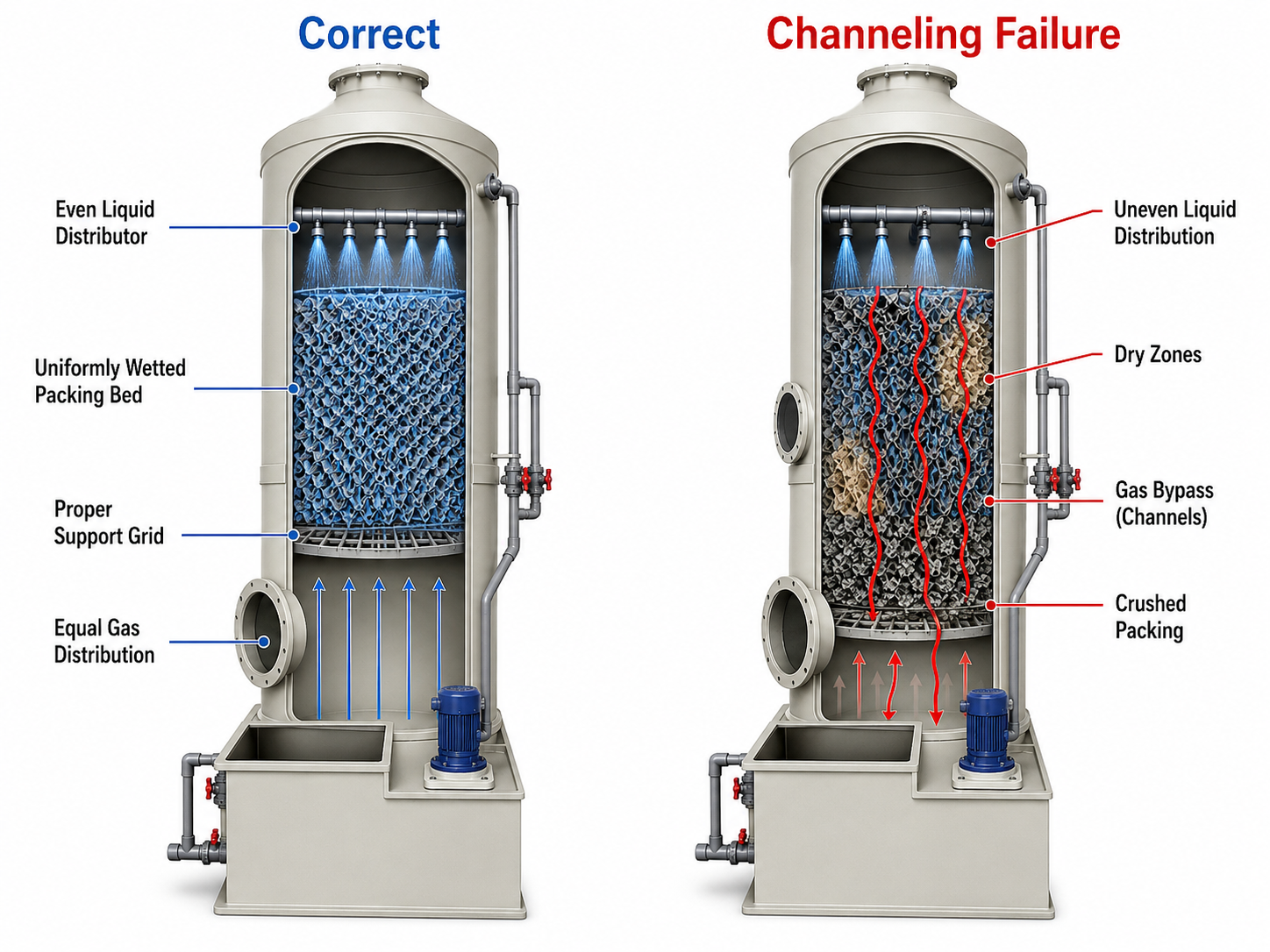
Mistake 2: Ignoring Liquid Distribution Design
Installing high-quality packing with a cheap liquid distributor guarantees poor performance. An uneven distributor creates dry zones where gas bypasses the wetted packing, reducing removal efficiency by 20-40%. The cost difference between a poorly designed distributor and a properly engineered one is typically $1,200-3,500 — far less than the cost of re-bedding.
Mistake 3: Selecting Metal Packing for Chloride Service
SS304 and SS316 pall rings in HCl or chloride-containing scrubbing service develop pitting corrosion within months. The dissolved iron from corroding metal rings contaminates the scrubbing liquor and can cause staining in downstream scrubbing stages. PP packing in the same service lasts 10-15 years with negligible material degradation at operating temperatures below 80°C.
Mistake 4: Assuming HETP Is Constant Across All Operating Conditions
HETP varies with gas velocity, liquid load, temperature, and the specific gas-liquid system. Using a single HETP value from a vendor data sheet without adjusting for your actual operating conditions leads to beds that are either undersized (efficiency shortfall) or oversized (wasted tower height).
Scrubber Packing Maintenance and Replacement
Packing failure is gradual, not catastrophic. Most operators detect the problem through rising pressure drop and outlet concentration drift long before visible damage appears in the bed.
Signs That Your Packing Needs Replacement
- 20% increase in differential pressure at constant fan speed indicates fouling, scaling, or bed collapse. Record baseline pressure drop at commissioning and compare monthly.
- Outlet concentration drift despite stable chemical dosing and pH signals channeling through the bed. The gas is finding paths through dry zones where the packing has shifted or fouled.
- Visible fragments in the sump mean the bed has already lost 15-30% of its active surface area. This is a late-stage indicator that requires prompt replacement.
Expected Lifespan by Material and Service
| Material | Acid-gas scrubbing (HCl, SO₂) | Alkaline scrubbing (NH₃, amine) | High-temp service (>100°C) |
|---|---|---|---|
| PP/Polypropylene | 10-15 years | 8-12 years | Not suitable |
| PVDF | 12-18 years | 10-15 years | 5-8 years |
| SS316 | 2-5 years (chloride pitting) | 8-12 years | 8-15 years |
| Ceramic | 5-8 years (cracking) | 3-6 years (caustic attack) | 8-12 years |
Packing Replacement Procedure
A standard packing replacement for a 1.5 m diameter scrubber with 3 m of packed height takes 2-3 days. The old packing is removed through the tower manway, the support grid is inspected and repaired if corroded, new packing is installed (dumped dry for PP rings, wet-packed for ceramic), and the bed is leveled. After reassembly, a 24-hour commissioning run verifies pressure drop, liquid distribution, and outlet concentration before returning the scrubber to service.
For a complete maintenance schedule covering packing, liquid distributors, and support grids, see our industrial scrubber maintenance guide.
FAQ
What is the difference between random packing and structured packing?
Random packing consists of individual pieces (rings, saddles, spheres) dumped into the tower to form an irregular bed. Structured packing uses corrugated sheets or knitted wire arranged in precise layers. Random packing costs less and is easier to install, while structured packing offers 25-40% better HETP (0.3-0.5 m per stage) and lower pressure drop. Structured packing costs 1.8-3x more per unit volume.
What is HETP in scrubber packing?
HETP (Height Equivalent to a Theoretical Plate) is the height of packing required to achieve one theoretical stage of mass transfer. For PP random packing in acid-gas service, HETP ranges from 0.4-0.8 m depending on gas velocity and liquid load. Structured packing achieves HETP of 0.3-0.5 m. Lower HETP means less packed height is needed for the same removal efficiency.
Which packing material is best for HCl scrubbing?
Polypropylene (PP) is the standard choice for HCl scrubbing. It resists hydrochloric acid across all concentrations at temperatures up to 80°C and typically lasts 10-15 years. Metal packing (SS304/SS316) pits within months in chloride environments, and ceramic packing dissolves if hydrofluoric acid is present in the gas stream as a co-contaminant.
How long does PP packing last in a scrubber?
PP packing lasts 10-15 years in acid-gas scrubbing service (HCl, SO₂, H₂S) at temperatures below 80°C. In alkaline service or applications with temperature cycling, the lifespan drops to 8-12 years. The primary failure mode is not material degradation but fouling or mechanical damage from pressure surges and thermal cycling.
How deep should a packed bed be in a scrubber?
For most industrial scrubbers, packed bed depth ranges from 1.5 m to 4 m depending on the required removal efficiency, gas velocity, and packing HETP. A typical HCl scrubber removing 500 ppm down to 5 ppm requires approximately 2.5-3.5 m of 25 mm Pall rings. The exact height should be calculated using your inlet and outlet concentrations.
When should I replace scrubber packing?
Replace packing when differential pressure increases by 20% or more at constant fan speed, when outlet concentration drifts upward despite stable chemical dosing, or when packing fragments appear in the sump. For most PP-packed scrubbers in clean acid-gas service, replacement is needed every 10-15 years.
Can Pall rings be used in cooling towers?
Yes, plastic Pall rings (typically PP) are used as fill media in cooling towers. They provide good water distribution and heat transfer surface area while maintaining low pressure drop. PP Pall rings resist biological growth and scaling when proper water treatment is maintained, making them a durable cooling tower fill option with a typical lifespan of 8-12 years.
Conclusion
Selecting the right scrubber packing media is a design-stage decision with consequences that last 10-15 years. The geometry determines mass transfer efficiency, the material determines service life and temperature range, and the size determines pressure drop and fouling resistance. No single packing type is best for all applications, but following the five-step selection process — chemical compatibility, size, pressure drop, fouling, and support design — eliminates the most common and costly selection errors.
XICHENG EP LTD manufactures scrubber packing media in PP, PVDF, metal, and ceramic variants, with over 2,600 systems shipped to 60+ countries since 2008. Our process engineers assist clients with packing selection, bed depth calculation, and support grid design for new scrubber installations and replacement packing projects.
Contact XICHENG EP for packing selection assistance →
Related Articles
- Packed Bed Scrubber Working Principle and Design — How packing interacts with other scrubber internals
- Scrubber Pressure Drop Calculation — Methods for packed bed and tray column pressure drop
- Gas Scrubber Design Calculation — Complete engineering guide with worked examples
External References
- EPA Air Quality Implementation Plans — Regulatory framework for emission control
- ISO 10692: Gas cylinders — Gas cylinder valve connections for use in micro-electronics industry — Relevant industry standard for gas handling
Author: Corbin, Applications Engineer at XICHENG EP LTD. With over 10 years of experience designing and installing scrubber systems across 30+ countries, Corbin specializes in packing media selection and mass transfer optimization for acid-gas scrubbing applications.