In 2020, an electroplating plant in Thailand installed a packed tower scrubber on their chrome plating line exhaust. Four months later, the packing was plugged solid with chromium hydroxide precipitate. The operators pulled 800 kg of packing by hand and replaced it. Eight months later — same thing. On the third failure, they called us. The fix was removing the packing entirely, installing spray nozzles, and converting the existing tower shell into a spray tower. The conversion cost $4,200. The packing changeouts had cost $9,600 in labor and materials over 12 months, plus the production downtime. The spray tower conversion has been running for four years without a single plugging event.
A spray tower design standard reference doesn’t exist as a published ISO or ASME document — but the engineering parameters that govern spray tower performance are settled. The H/D ratio, gas velocity limits, nozzle selection criteria, and material compatibility rules covered in this guide represent the accumulated experience of thousands of industrial spray towers. Follow them and your scrubber works. Deviate without understanding why the limit exists, and you find out the hard way.
For specifications and pricing on spray tower systems engineered to your exact gas stream, browse our wet scrubber product catalog.
Key Takeaways
- A spray tower scrubber is the simplest wet scrubber design — a hollow vertical cylinder with spray nozzles, no packing, no trays. It’s the correct choice when your gas stream contains particulate that would plug packing. The trade-off is lower mass transfer surface area (~50–100 m² vs 3,000–5,000 m² per m³ for packed towers), which doesn’t matter for fast-reacting gases but limits efficiency on slow-reacting contaminants.
- The height-to-diameter ratio (H/D) must fall between 4 and 7. H/D=5–6 is the standard band for chemical scrubbing at 5,000–20,000 m³/h. Below H/D=4, the gas residence time in the spray zone is too short for effective mass transfer. Above H/D=7, the tower becomes uneconomically tall with diminishing returns.
- Superficial gas velocity in a hollow spray tower runs 1.0–1.5 m/s. The design starting point is 1.2 m/s. Below 1.0 m/s, droplets aren’t uniformly distributed. Above 1.5 m/s, droplets carry over into the mist eliminator and out the stack. For turbulent bed towers with floating packing balls, velocity can reach 5–6 m/s — but that’s a fundamentally different internal design.
- Nozzle selection determines spray tower performance more than any other factor. Full-cone spiral nozzles at 2–3 bar producing 0.6–1.0 mm droplets are the standard for industrial spray towers — they combine good atomization with the largest free passage for solids-laden recirculation. Inspect nozzles every 3–6 months. Clogged nozzles don’t show on the pressure gauge, and the first sign of failure is usually a failed stack test.
- The EPA wet scrubber monitoring reference provides the regulatory framework for spray tower compliance testing, and Torch-Air’s spray tower design guide covers nozzle types and operating principles. For the underlying mass transfer equations, see our gas scrubber design calculation guide.
What Is a Spray Tower Scrubber?
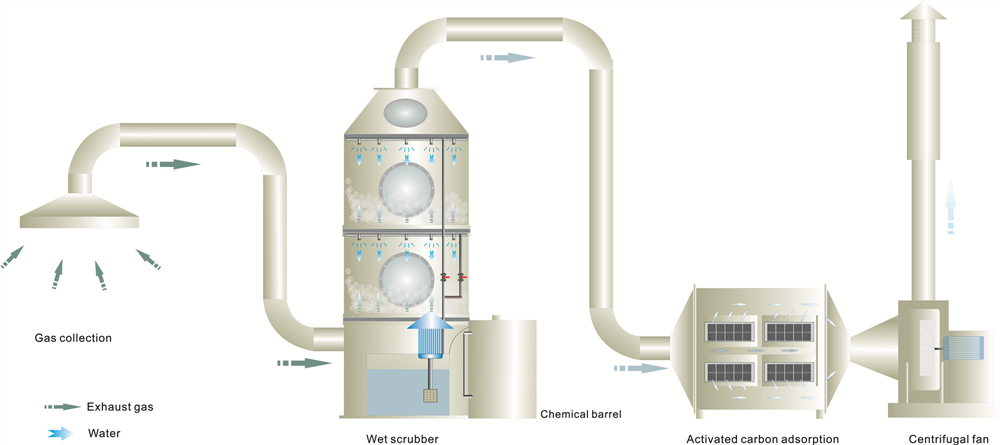
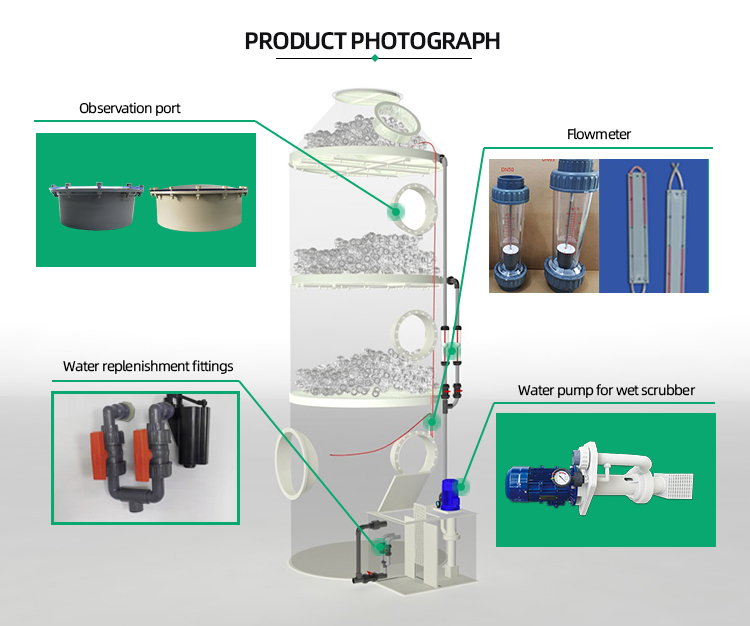
A spray tower scrubber — also called a spray chamber, hollow spray scrubber, or simply a spray tower — is the simplest type of wet scrubber used for industrial air pollution control. It’s a vertical cylindrical vessel with spray nozzles at the top and an empty chamber below. Contaminated gas enters at the bottom and rises countercurrently through a descending mist of scrubbing liquid. There is no packing, no trays, no internal moving parts. The gas-liquid contact happens entirely on the surface of the sprayed droplets.
Spray towers occupy a specific niche in the wet scrubber family: they handle the applications that would foul a packed bed. If your gas stream carries particulate — dust from grinding, fly ash from combustion, metal oxides from welding, sticky organic aerosols — a packed tower will eventually plug. The solids collect on the packing surface, channel the gas flow, and within months you’re pulling packing elements for cleaning. A spray tower type scrubber has nothing for particulates to catch on. The liquid washes everything down to the sump.
The trade-off is mass transfer efficiency. Packed towers provide 3,000–5,000 m² of gas-liquid contact surface per cubic meter of packing. A spray tower provides only the surface area of the droplets — roughly 50–100 m² for a φ1.5m tower at typical operating conditions. For a fast-reacting gas like HCl in caustic or ammonia in sulfuric acid, this lower surface area doesn’t matter — the reaction completes on contact, and the extra packing surface is unnecessary overhead. For slow-reacting gases or applications demanding 99.5%+ removal, the packed tower’s higher surface area translates directly to shorter column height.
Spray towers serve three primary functions in air pollution control:
- Gas absorption with chemical reaction — acid gases (HCl, SO₂, HF) neutralized by caustic spray, or ammonia neutralized by acid spray. This is the largest application by volume.
- Particulate removal — capture of coarse dust particles larger than 10–15 μm. Finer particles require Venturi or packed bed technology. Spray towers are not designed for submicron particulate capture — a Venturi scrubber provides 10–100× the collection efficiency on particles below 2 μm.
- Gas cooling and conditioning — hot exhaust gas quenched to saturation temperature before downstream treatment. A spray tower can drop 300°C gas to 60–80°C in under a second of contact time with atomized water.
The defining operational parameters — superficial gas velocity of 1.0–1.5 m/s, liquid-to-gas ratio of 0.5–1.5 L/m³, height-to-diameter ratio of 4–7 — are covered in detail in the design standards section below. These aren’t theoretical numbers. They represent the operating envelope within which industrial spray towers reliably deliver their design performance. Step outside any one of them — too fast, too little liquid, too short a tower — and the removal efficiency is the first thing to drop, usually without warning on the pressure gauge.
Spray Tower Design Standards: The Fixed Parameters
Spray tower design converges on a handful of fixed ratios and velocity limits that hold across manufacturers and applications. These aren’t theoretical — they come from decades of operating data across thousands of installations.
The H/D Ratio: 4 to 7
The height-to-diameter ratio of a spray tower is the single most important design parameter after the gas flow rate. The standard range is H/D = 4 to 7, where H is the total cylindrical shell height and D is the internal diameter. A tower at H/D = 4 is short and wide. A tower at H/D = 7 is tall and narrow. Both can be correct for different applications.
| H/D Ratio | Best For | Characteristics |
|---|---|---|
| 4–5 | High gas flow (>20,000 m³/h), coarse particulate, cooling duty, low concentration acid gas | Lower gas velocity at a given diameter. Less entrainment. Shorter spray zone — adequate for fast reactions |
| 5–6 | Standard industrial scrubbing — HCl, SO₂, NH₃ with chemical additive at 5,000–20,000 m³/h | Balanced. Most of our standard product line falls in this range |
| 6–7 | High removal efficiency (>99%), low inlet concentration, limited floor space, gases with slower reaction kinetics | Longer gas residence time in the spray zone. Higher pressure drop. More spray tiers needed to cover the height |
The spray section — from the top nozzle tier to the gas inlet — accounts for 50% or more of the total tower height. For a φ1.5m tower at H/D=6 (total height 9m), the spray section runs roughly 5–6 meters, with 2–3 tiers of spray nozzles spaced 1.5–2.0 meters apart vertically.
Gas Velocity: 1.0–1.5 m/s Maximum
The superficial gas velocity in a hollow spray tower must stay between 1.0 and 1.5 m/s. Below 1.0 m/s, the falling droplets are not adequately suspended — the liquid distribution becomes uneven and some cross-sections go dry. Above 1.5 m/s, droplet entrainment becomes severe — liquid droplets are carried upward into the mist eliminator and, if the eliminator is undersized, out the stack as a visible plume.
For turbulent bed spray towers using lightweight floating packing balls (density < scrubbing liquid density), the velocity limit increases to 5–6 m/s — the balls tumble in the gas stream and the bed expands, creating turbulence that enhances mass transfer. But turbulent bed towers are a specialized subset; the standard hollow spray design operates at the 1.0–1.5 m/s limit.
Liquid-to-Gas Ratio: 0.5–0.9 L/m³
For a hollow spray tower without packing, the L/G ratio runs 0.5–0.9 L/m³. Water-only spray towers for dust removal operate at the low end (0.5–0.7). Chemical spray towers with reactive solutions — acid for ammonia, caustic for HCl — operate at the high end (0.7–1.5 L/m³) because the chemical consumption demands a higher liquid turnover.
The relationship between L/G and efficiency is not linear. Below 0.5 L/m³, the spray density is too low to cover the tower cross-section uniformly — dry spots appear and efficiency drops sharply. Above 1.5 L/m³ in a hollow tower, the additional liquid increases droplet coalescence (droplets merge into larger ones), which reduces the total gas-liquid contact area. The sweet spot — 0.7 to 0.9 L/m³ — gives the best balance of spray coverage and droplet surface area for most industrial applications.
Dehydration Section and Mist Elimination
Above the top spray tier, the dehydration section allows large droplets to fall back by gravity. It occupies roughly 20–25% of the total tower height. Inside this section, a mist eliminator — typically a chevron (vane-type) or mesh-pad demister — captures droplets above 10 μm before the gas exits. The face velocity through the demister must stay below 2.5 m/s for chevron type, 3.5 m/s for mesh pad type. Exceed these limits and the demister floods, sending liquid droplets out the stack.
Quick Reference: Standard Spray Tower Dimensions
| Gas Flow (m³/h) | Diameter (m) | H/D=5 Total Height (m) | H/D=6 Total Height (m) | Spray Tiers | Typical Pump (kW) |
|---|---|---|---|---|---|
| 3,000 | 0.8 | 4.0 | 4.8 | 1–2 | 1.1 |
| 5,000 | 1.0 | 5.0 | 6.0 | 2 | 1.5 |
| 10,000 | 1.5 | 7.5 | 9.0 | 2–3 | 2.2 |
| 15,000 | 1.8 | 9.0 | 10.8 | 3 | 3.0 |
| 20,000 | 2.0 | 10.0 | 12.0 | 3 | 4.0 |
| 30,000 | 2.5 | 12.5 | 15.0 | 3–4 | 5.5 |
These dimensions are based on 1.2 m/s superficial velocity and a single-layer spray design. Multi-layer spray configurations (common for higher efficiency targets) can reduce the total height by 15–20% at the same removal efficiency because the additional spray tiers provide more contact stages in series.
Spray Tower Sizing: Diameter from Airflow, Height from H/D
A spray tower scrubber sizing calculation answers two questions: how wide (diameter), and how tall (height). The diameter follows from the gas flow rate and the allowable superficial velocity. The height follows from the H/D ratio and the number of spray stages your removal efficiency target demands.
Step 1: Calculate Diameter
The diameter of a spray tower is determined by the required gas flow rate and the design superficial velocity:
D = √(4 × Q_g / (π × u_sg × 3600))
Where:
- D = tower internal diameter (m)
- Q_g = gas flow rate (m³/h)
- u_sg = design superficial gas velocity (m/s) — use 1.2 m/s as the starting point for a hollow spray tower
Worked example — 10,000 m³/h spray tower:
D = √(4 × 10,000 / (π × 1.2 × 3,600)) = √(40,000 / 13,572) = √2.95 = 1.72 m
Round up to the nearest standard fabrication increment — 1.8 m diameter (PP and FRP towers are fabricated in 100 mm increments above 1.0 m). Actual operating velocity at 1.8 m: u_sg = 4 × 10,000 / (π × 1.8² × 3,600) = 1.09 m/s — within the acceptable 1.0–1.5 m/s range.
Step 2: Determine Height from H/D Ratio
Once the diameter is fixed, the total tower height follows from the selected H/D ratio:
| H/D Ratio | Height for D=1.8m | Removal Efficiency | Application |
|---|---|---|---|
| 4 | 7.2 m | 85–90% — coarse dust, cooling duty | Pre-scrubber, quench tower |
| 5 | 9.0 m | 90–95% — standard acid gas with chemical reaction | HCl, SO₂ with NaOH |
| 6 | 10.8 m | 95–98% — higher efficiency, slower reactions | NH₃ with H₂SO₄, multi-stage |
| 7 | 12.6 m | 98–99% — maximum spray contact time, tallest practical | HF removal, critical emission limits |
The spray zone — from the top nozzle tier to the gas inlet — should occupy 50–55% of the total height. For the H/D=5 case at H=9.0m, the spray zone runs approximately 4.5–5.0 meters. Above the spray zone, the dehydration section with the mist eliminator takes roughly 20–25% of the height (1.8–2.3m). Below the gas inlet, the sump section occupies the remaining 20–25% (1.8–2.3m).
Step 3: Verify Gas Residence Time
The gas residence time in the spray zone must exceed 1.5–3.0 seconds for effective mass transfer. For a 1.8m diameter tower with a 5.0m spray zone:
Residence time = spray zone height / superficial velocity = 5.0 / 1.09 = 4.6 seconds
This exceeds the 3.0-second upper guideline. The tower could be shortened — H/D=4 (7.2m total, ~4.0m spray zone, ~3.7 seconds residence) would still provide adequate contact time for standard acid gas scrubbing. This is the kind of iteration that real spray tower scrubber design calculation requires: run the numbers, check against the constraints, adjust, and re-run.
Nozzle Types and Spray Distribution
The nozzles are the component that determines whether a spray tower works or doesn’t. Every other design parameter — diameter, height, H/D ratio, gas velocity — can be correct on paper, but if the nozzles produce droplets that are too large (low surface area, poor mass transfer) or too small (carried out the stack), the scrubber fails. Nozzle selection is not a secondary decision. It is as fundamental as sizing the column.
Nozzle Performance Requirements
A spray tower nozzle must meet four criteria simultaneously:
- Droplet size: 0.6–1.0 mm (600–1000 μm) Sauter mean diameter. Below 500 μm, droplets are carried upward by the gas flow — even at 1.0 m/s superficial velocity — and end up in the mist eliminator. Above 1.5 mm, the total surface area per liter of liquid drops below the threshold needed for efficient mass transfer. The Sauter mean diameter — the diameter of a droplet with the same volume-to-surface-area ratio as the entire spray — is the standard comparative measure.
- Spray cone angle: 60–120°. Wider angles cover more cross-sectional area per nozzle, reducing the total number of nozzles needed. But cone angles above 120° produce a hollow cone with poor droplet density at the center. Full-cone nozzles with 60–90° are the standard for spray tower applications because they deliver uniform droplet density across the cone.
- Operating pressure: 2–4 bar (30–60 psi). Below 2 bar, atomization is poor — the liquid exits as coarse streams rather than a mist. Above 4 bar, the pump power consumption increases without meaningful improvement in droplet size or distribution. The sweet spot is 3 bar — good atomization, reasonable pump power.
- Clog resistance. The minimum free passage through the nozzle orifice must be at least 2–3 times the largest expected particle size in the recirculated liquid. For a spray tower handling dust-laden gas, this means nozzle orifices of 5–10 mm minimum — which limits how fine a droplet the nozzle can produce at a given pressure.
Nozzle Types for Spray Tower Scrubbers
| Nozzle Type | Droplet Size Range | Cone Angle | Clog Resistance | Best For |
|---|---|---|---|---|
| Full-cone spiral | 0.5–1.5 mm at 2–3 bar | 60–90° | Excellent — largest free passage for a given flow rate | Dirty liquids, recirculated scrubbing solution with suspended solids. The default choice for industrial spray towers |
| Full-cone axial whirl | 0.3–0.8 mm at 2–4 bar | 60–90° | Moderate — internal vane can trap fibers and scale | Clean liquids, chemical scrubbing with filtered recirculation. Finer droplets than spiral, better for gas absorption |
| Hollow-cone tangential | 0.3–0.7 mm at 2–4 bar | 90–120° | Good — tangential inlet avoids internal obstructions | Wide coverage per nozzle. Used when minimizing nozzle count is prioritized, at the cost of some droplet density at the cone center |
| Flat fan | 0.5–2.0 mm at 1–3 bar | Narrow (elliptical pattern) | Good — simple slot orifice | Crossflow spray towers, where the gas moves horizontally and nozzles are arranged in banks perpendicular to gas flow |
Nozzle Layout and Spray Coverage
The nozzles must be arranged to provide uniform spray density across the entire tower cross-section. The standard layout for a circular tower is a concentric ring pattern — one nozzle at the center, a ring of 4–6 nozzles at 40% of the radius, and another ring of 6–8 nozzles at 75% of the radius. Total nozzle count for a φ1.5m tower typically runs 12–18 nozzles per spray tier.
Spray overlap between adjacent nozzles should be 20–30% at the plane where the spray cones intersect — typically 1.0–1.5 meters below the nozzle tips. Too little overlap and you get dry bands. Too much overlap and you waste pump power on redundant spray density.
For towers taller than 5 meters of spray zone, multiple spray tiers — spaced 1.5–2.0 meters apart vertically — provide staged gas-liquid contact. A two-tier system with 2.0m spacing effectively doubles the number of contact stages without increasing the tower diameter. Each tier should have its own liquid supply header with an isolation valve so individual tiers can be serviced without shutting down the entire tower.
Nozzle Material and Maintenance
Spray nozzles in acid gas service should be PP, PVDF, or 316 stainless steel depending on temperature and chemical compatibility. PP nozzles handle temperatures up to 80°C and resist caustic and most acids except strong oxidizers. PVDF handles up to 140°C. 316 stainless nozzles handle high temperature but are vulnerable to chloride pitting — do not use SS316 nozzles in HCl or Cl₂ scrubbing service.
Inspect nozzles every 3–6 months. Clogged nozzles reduce spray coverage, create dry bands, and drop removal efficiency without any change in pressure drop or liquid flow readings. A boroscope inspection through the tower access port takes 15 minutes; the stack test failure that results from undetected nozzle clogging costs a day of downtime and a retest fee. Budget $50–200 per nozzle for replacement depending on material.
Comparing Spray Tower, Packed Tower, and Tray Tower
A spray tower vs packed tower decision is one of the first questions that comes up when specifying a wet scrubber. Each of the three main gas-liquid contactor types — spray, packed, and tray — solves the same problem differently. The right choice depends on your gas cleanliness, your removal efficiency target, and your tolerance for maintenance downtime.
| Feature | Spray Tower | Packed Tower | Tray Tower |
|---|---|---|---|
| Gas-liquid contact mechanism | Droplet surface area — liquid atomized into fine mist | Liquid film on packing surface — rings, saddles, structured media | Bubbles through liquid pools on perforated plates |
| Superficial gas velocity | 1.0–1.5 m/s | 0.3–0.5 m/s | 0.6–1.2 m/s |
| Pressure drop | 50–200 Pa/m — lowest of the three | 100–800 Pa/m depending on packing type and liquid load | 200–600 Pa per tray |
| Liquid-to-gas ratio | 0.5–1.5 L/m³ | 0.7–2.0 L/m³ | 1.0–3.0 L/m³ |
| Particulate tolerance | Excellent — nothing to clog. The deciding factor for dirty gas | Fair — packing plugs with solids, scale, or precipitates | Poor — tray holes plug. Requires clean liquids |
| Capital cost (10,000 m³/h) | $8,000–15,000 (simple construction) | $12,000–25,000 (packing + supports + distributors) | $15,000–35,000 (complex fabrication) |
| Maintenance | Minimal — nozzles only wear item | Moderate — packing replacement every 5–8 years | Higher — tray inspection, gasket replacement |
| Mass transfer surface area | ~50–100 m² (droplet surface only) | ~3,000–5,000 m² per m³ of packing | ~200–500 m² per tray |
The comparison between spray and packed towers comes down to one question: is your gas stream clean enough for packing? If the answer is yes, a packed tower gives you more mass transfer surface area per meter of column height, which translates to a shorter column or higher removal efficiency. But packed towers demand liquid distribution that wet every piece of packing evenly — undershoot the minimum wetting rate and the column develops dry channels that gas bypasses entirely. Spray towers are more forgiving: if the nozzles are working and the tower is tall enough, the spray covers the cross-section by default.
Tray towers are the right answer when you need staged contacting with a precisely controlled liquid residence time per stage. They’re the standard in large-scale chemical processing — distillation columns, acid gas absorbers in refineries, flue gas desulfurization at power plants — because each tray provides a discrete equilibrium stage with well-defined composition. For industrial exhaust scrubbing at under 50,000 m³/h, a tray tower is almost always overengineered and overpriced compared to either a spray or packed tower. The exception: when the scrubbing reaction produces a precipitate (e.g., limestone scrubbing for SO₂ produces gypsum), tray towers with large-diameter valves handle the solids better than packed beds, though at higher capital cost than a spray tower.
For most industrial acid gas scrubbing applications under 30,000 m³/h, the decision tree is straightforward: dirty gas → spray tower. Clean gas, high efficiency target → packed tower. Large scale with staged equilibrium requirements → tray tower. In practice, roughly 70% of the units we sell in the 3,000–20,000 m³/h range are spray towers — not because they’re the most efficient, but because the gas is dirty and the operators have better things to do than change packing.
Spray Tower Applications and Material Selection
Where Spray Towers Excel
Spray tower applications cluster around processes that produce dirty, hot, or chemically aggressive exhaust. The spray tower’s open internal geometry — no packing, no trays — makes it the first choice when any of those three conditions applies.
| Industry | Application | Contaminants | Why Spray Tower |
|---|---|---|---|
| Metal finishing / pickling | HCl, H₂SO₄ mist removal from pickling baths | Hydrogen chloride, sulfuric acid mist | Acid mist plus iron chloride particulate — packed beds plug within months |
| Chemical processing | Reactor vent scrubbing | HCl, Cl₂, SO₂, NH₃ — varies by process | Multi-gas flexibility. Chemical solution change handles different contaminants without equipment modification |
| Power generation | Flue gas desulfurization (FGD) | SO₂ | Very large gas volumes (100,000+ m³/h). Spray towers scale to the largest diameters economically |
| Fertilizer production | Ammonia and urea dust scrubbing | NH₃, urea particulate | Particulate plus gas — dual duty that a packed bed can’t handle without frequent cleaning |
| Waste incineration | Quench + acid gas scrubbing | HCl, SO₂, heavy metals, dioxins | High inlet temperature (200–400°C). Spray quench cools gas to saturation in under 1 second. Packing melts at these temperatures |
| Food processing | Odor control from rendering, frying, fermentation | VOCs, amines, organic acids | Low pressure drop, simple operation. Chemical additive (oxidizer) in spray water handles intermittent loads |
| Electroplating | Chromium, cyanide mist control | Cr⁶⁺ mist, HCN gas | Highly toxic — the spray tower’s simplicity means fewer maintenance entries into the contaminated zone |
Material Selection for Spray Tower Construction
| Material | Max Temp | Acid Resistance | Alkali Resistance | Cost (relative) | Best For |
|---|---|---|---|---|---|
| PP (Polypropylene) | 80°C | Excellent — HCl, H₂SO₄ (dilute), HF, H₃PO₄ | Excellent — NaOH, KOH | 1.0× | 70% of spray tower applications. Below 80°C, PP is the default material. Easily repaired by hot gas welding on site |
| FRP (Vinyl Ester) | 180°C | Good — broad acid resistance | Fair — specify vinyl ester; standard polyester degrades in NaOH | 1.5–2.0× | Temperatures above 80°C, tall towers (>6m) where PP’s low stiffness requires external bracing |
| SS304 | 800°C | Poor — HCl and chlorides cause pitting at any concentration | Good | 1.8–2.5× | Clean caustic service only. Not for acid gas scrubbing — chloride pitting perforates a 3mm wall in 6–12 months |
| SS316L | 800°C | Fair — molybdenum helps but HCl still attacks | Good | 2.0–3.0× | High temperature where PP fails but acid loading is low. Nitric acid scrubbing. Not for HCl or chloride service |
| Hastelloy C276 | 1,000°C+ | Excellent — all common acids including HCl, H₂SO₄, wet Cl₂ | Good | 8–12× | Extreme chemistry where nothing else survives. At $80–120/kg fabricated, budget exceeds the building cost |
For spray towers specifically, material selection is influenced by the nozzle chemistry as well as the gas stream. The recirculating liquid — often acidic in the sump of an ammonia scrubber, or caustic in the sump of an HCl scrubber — determines the pump, piping, and nozzle materials more than the gas composition does. A spray tower handling 200°C acid gas can use PP for the shell if a quench spray cools the gas to below 80°C before it reaches the tower wall. The quench nozzles themselves — the first point of contact with hot gas — must be PVDF or 316L, but the rest of the tower can be PP. This staged material approach — high-spec at the hot inlet, standard PP everywhere else — cuts cost by 30–40% compared to building the entire tower in FRP.
Frequently Asked Questions
What is the typical H/D ratio for a spray tower?
The standard height-to-diameter ratio for industrial spray towers is 4 to 7. H/D=4–5 is used for high gas flow rates (>20,000 m³/h) and coarse particulate removal. H/D=5–6 is the standard range for chemical scrubbing (HCl, SO₂, NH₃). H/D=6–7 is reserved for high-efficiency applications (99%+ removal) or when floor space is limited. The spray section occupies 50–55% of the total tower height.
How fast should gas move through a spray tower?
The superficial gas velocity in a hollow spray tower must stay between 1.0 and 1.5 m/s. Below 1.0 m/s, the falling droplets are not uniformly distributed across the cross-section. Above 1.5 m/s, liquid droplets are entrained upward into the mist eliminator and out the stack. The design starting point is 1.2 m/s — this provides margin on both the low and high ends for process variations.
How much does a spray tower scrubber cost?
For a PP spray tower in the 5,000–15,000 m³/h range, equipment cost (tower shell, spray nozzles, mist eliminator, sump — no pump, no fan) runs $8,000–$20,000 ex-works. A complete installed system including recirculation pump, fan, ductwork, instrumentation, and commissioning typically runs $25,000–50,000 depending on site conditions and material of construction. FRP adds 50–100% to the equipment cost. Annual operating cost for a 10,000 m³/h spray tower: $3,000–$8,000 (pump electricity + chemical consumption + nozzle replacement amortized).
What’s the difference between a spray tower and a packed tower scrubber?
A spray tower uses atomized droplets as the gas-liquid contact surface — no internal packing. A packed tower uses random or structured packing media. Spray towers tolerate dirty gas streams and have lower pressure drop (50–200 Pa/m vs 100–800 Pa/m). Packed towers provide 30–100× more gas-liquid contact surface area and achieve higher removal efficiency at the same column height for slow-reacting gases. The deciding factor is usually particulate loading: if the gas carries solids that would plug packing, specify a spray tower.
How often do spray nozzles need replacement?
Spray nozzles in clean chemical service (filtered recirculation) last 2–4 years. In dirty service with suspended solids in the recirculation liquid, expect 6–12 months before erosion enlarges the orifice and degrades spray pattern. Inspect every 3–6 months. A clogged or eroded nozzle reduces spray coverage without changing the pressure gauge reading — the only reliable inspection method is visual (boroscope through the access port) or removal for bench testing.
Conclusion
A spray tower scrubber is the right answer when your gas is dirty, your pressure drop budget is tight, or your maintenance crew has more important things to do than unload packing. The H/D ratio, gas velocity, and nozzle selection covered here are the settled parameters — the numbers that decades of operating data have converged on — not theoretical starting points that need site-specific optimization. Size the diameter from your airflow. Set the height from the H/D ratio. Select the nozzles for your liquid chemistry and particulate loading. The scrubber will perform.
For specifications and pricing on spray tower systems built to your gas flow and contaminant profile, browse our wet scrubber product catalog or contact our engineering team with your design parameters.