

H2S Scrubber System: Industrial Hydrogen Sulfide Removal
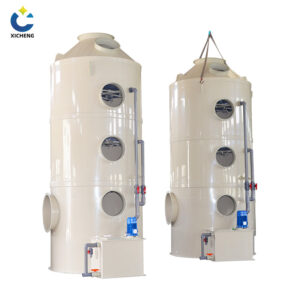
An H2S scrubber system removes hydrogen sulfide — a toxic, corrosive gas with a characteristic rotten-egg odor — from industrial exhaust, biogas, and foul air streams. Using chemical absorption in a packed column, the scrubber converts gaseous H₂S into a dissolved salt or elemental sulfur at 95-99% removal efficiency. Our systems are custom-engineered in PP, FRP, or dual-laminate construction, sized to your exact gas flow rate, inlet H₂S concentration, and outlet permit limit.
| Key Specifications at a Glance | |
|---|---|
| Removal Efficiency | 95-99%+ (stack-tested per EPA Method 15) |
| Flow Rate Range | 500 – 100,000 CFM (850 – 170,000 m³/hr) |
| Inlet H₂S Concentration | 10 – 50,000+ ppm |
| Outlet H₂S | <1 ppm (odor threshold) to <10 ppm (health compliance) |
| Construction Materials | PP / FRP / Dual-Laminate / PVC |
| Scrubbing Chemistry | NaOH (caustic) / NaOCl (oxidative) / Chelated Iron |
| Control System | PLC with pH/ORP auto-dosing, Modbus/4-20 mA output |
Why Our H2S Scrubber Is Different
Custom-Engineered, Not Catalog-Selected
We do not sell off-the-shelf units. Every H2S scrubber is sized to your actual gas flow, H₂S concentration, temperature, and site constraints. You get a system that fits your process — not a compromise that nearly fits.
Three Scrubbing Chemistries, One Honest Recommendation
We build caustic (NaOH), oxidative (NaOCl/H₂O₂), and chelated-iron catalyst systems. We ask about your waste-handling capabilities and operating budget, then recommend the chemistry that gives you the lowest total lifecycle cost — not the one with the highest margin for us.
PP Construction With No Internal Lining
Our PP scrubbers are corrosion-resistant through the full wall thickness. No internal coatings to blister. No stainless steel to pit from chlorides or crack from sulfide stress. For temperatures above 80°C, we upgrade to FRP or dual-laminate. The material choice is driven by your process conditions, not our inventory.
Automated Chemistry, Not Manual Dosing
Every system ships with a PLC, inline pH/ORP probes, and automatic chemical dosing. When your H₂S load spikes, the controller catches it in seconds — not when an operator notices the outlet odor. Remote monitoring via Modbus or 4-20 mA connects to your plant DCS.
About XICHENG EP
XICHENG EP LTD is an industrial air pollution control equipment manufacturer with 16+ years of production experience, 2,600+ systems shipped, and installations in 60+ countries. We manufacture in Shenzhen, China, with in-house PP fabrication, FRP winding, and assembly capabilities. Every H2S scrubber undergoes a water-tightness test, electrical continuity check, and full-load recirculation test before crating and shipment.
Core Advantages
- In-house manufacturing: PP sheet extrusion, CNC cutting, hot-gas welding, and FRP filament winding all under one roof — no outsourced fabrication, no subcontractor delays
- Material traceability: Full mill certificates for PP resin, FRP resin, and structural steel. Material batch numbers traceable to your project number
- Pre-assembly testing: Every scrubber is dry-assembled in our shop before shipping. What arrives on site fits — we do not debug welds in the field
- Documentation package: Each system ships with P&ID, GA drawing, O&M manual, material certs, and a performance test procedure ready for your permit submittal
- After-sales support: Remote commissioning assistance via video call, spare parts stocked for 10 years post-delivery, and 1-year warranty on workmanship and materials
Certifications and Compliance
- CE Marking — Machinery Directive 2006/42/EC, EMC Directive 2014/30/EU
- RoHS — 2011/65/EU compliant materials
- ISO 9001:2015 — Quality management system
- ISO 14001:2015 — Environmental management system
- SGS material testing — PP sheet, FRP laminate, weld integrity
- Designed to meet US EPA NESHAP and OSHA 1910.94 ventilation standards
- Design basis per EU 2010/75/EU Industrial Emissions Directive (IED)
How H2S Scrubbing Works
Hydrogen sulfide removal uses chemical absorption — the H₂S-laden gas contacts a scrubbing solution inside a packed column, where a fast chemical reaction converts the gaseous pollutant into a non-volatile compound that stays dissolved in the liquid phase. The cleaned gas exits through a demister at the top; the spent scrubbing liquid is recirculated with automatic chemical replenishment.
Method 1: Caustic Scrubbing (NaOH)
The most widely used H2S scrubbing method. Reaction: H₂S + 2NaOH → Na₂S + 2H₂O. Sodium sulfide remains dissolved in the scrubbing liquid. Removal efficiency: 95-99% at L/G ratio 0.7-0.9 L/m³ with 1.0-1.2 m of PP packing depth. Chemical cost: $0.30-0.60 per kg H₂S removed. Spent caustic requires oxidation before discharge — typically air sparging in a separate tank. See our caustic scrubber system guide for detailed design parameters.
Method 2: Oxidative Scrubbing (NaOCl or H₂O₂)
Oxidizing agents convert H₂S directly to elemental sulfur: H₂S + NaOCl → S↓ + NaCl + H₂O. The sulfur precipitates as a fine yellow solid, filtered from the recirculation loop. Preferred when spent liquid discharges to municipal sewer — sulfate is far less regulated than sulfide. Chemical cost: $0.80-1.50 per kg H₂S removed. Higher chemical cost than caustic, but lower waste treatment cost often makes this the cheaper total-cost solution.
Method 3: Chelated Iron (for loads above 100 kg H₂S/day)
For continuous high-load applications, a chelated iron catalyst cycles between Fe³⁺ and Fe²⁺: H₂S + 2Fe³⁺ → S↓ + 2Fe²⁺ + 2H⁺. The catalyst is regenerated by air oxidation and is not consumed. Only air and small chelating-agent makeup are required. Higher capital cost than caustic, but for loads above 200 kg H₂S/day, the payback from eliminated chemical purchases is typically 12-18 months.
Technical Specifications
| Parameter | Caustic System | Oxidative System |
|---|---|---|
| H₂S inlet range | 10 – 50,000+ ppm | 10 – 5,000 ppm |
| H₂S outlet | <1 – 10 ppm | <1 – 5 ppm |
| Removal efficiency | 95-99% | 97-99%+ |
| L/G ratio | 0.7-0.9 L/m³ | 0.5-0.8 L/m³ |
| Packing depth | 1.0-1.2 m (PP Pall rings) | 0.8-1.0 m (PP Pall rings) |
| Gas velocity | 1.0-1.5 m/s | 1.0-1.5 m/s |
| Operating pH | 8-10 | 7-9 (NaOCl) / 8-10 (H₂O₂) |
| Chemical consumption | ~2.4 kg NaOH / kg H₂S | ~2.1 kg NaOCl / kg H₂S |
| Waste product | Na₂S solution (requires oxidation) | Elemental S slurry (filterable) |
| Materials | PP / FRP / Dual-Laminate | PP / FRP (NaOCl compatible) |
Industries and Applications
| Industry | H₂S Source | Typical Concentration | Recommended Chemistry |
|---|---|---|---|
| Wastewater treatment | Headworks, clarifiers, sludge dewatering | 10-500 ppm | NaOH + NaOCl two-stage |
| Biogas purification | Anaerobic digester gas | 500-5,000 ppm | NaOH or chelated iron |
| Petroleum refining | Sour water stripper, fuel gas, flare gas | 1,000-50,000+ ppm | NaOH with spent caustic oxidation |
| Natural gas processing | Raw natural gas, amine tail gas | 500-20,000 ppm | Amine + caustic polishing |
| Chemical manufacturing | Reactor vents, sulfur recovery tail gas | 100-5,000 ppm | NaOH or NaOCl |
| Pulp and paper | Kraft process, black liquor oxidation | 100-2,000 ppm | NaOH with NaOCl polishing |
How to Order
- Send your operating data: Gas flow rate (CFM or m³/hr), inlet H₂S concentration (ppm), required outlet limit per your permit, gas temperature, and available site footprint. Contact our engineering team at air-emissions.com/contact.
- Receive your proposal: Within 48 hours, we provide a preliminary sizing, process flow diagram, budget price, and delivery timeline — no obligation.
- Review and approve: Once the proposal meets your requirements, we issue a formal quotation with detailed technical specifications.
- Engineering and drawing approval: We produce the P&ID, general arrangement drawing, and electrical schematic for your review and sign-off before fabrication begins.
- Manufacturing and testing: 6-10 weeks fabrication. Pre-shipment water-tightness test, recirculation test, and control system checkout. You are welcome to inspect at our facility or via video call.
- Shipping and commissioning: Containerized sea freight or air freight. Remote commissioning support via video call included. Optional on-site supervision available.
Complete Your System
An H2S scrubber works best as part of an integrated air treatment system:
- Upstream: PP ductwork to convey H₂S-laden exhaust from the source to the scrubber inlet — corrosion-resistant, single-material system eliminates duct leaks
- Downstream: Activated carbon adsorber as a polishing stage for residual H₂S and odor compounds below 1 ppm
- Liquid waste: Spent caustic oxidation tank — air sparging or peroxide dosing to convert sulfides to sulfates before sewer discharge
- Monitoring: Continuous H₂S analyzer at the stack outlet with data logging for compliance reporting
Global Shipping
We ship H2S scrubber systems worldwide from our Shenzhen manufacturing facility. Regular containerized sea freight to ports in North America (Los Angeles, Houston, New York), Europe (Rotterdam, Hamburg, Antwerp), the Middle East (Jebel Ali, Dammam), Southeast Asia (Singapore, Port Klang), and Australia (Sydney, Melbourne). Air freight available for urgent deliveries and smaller units. All equipment is crated, shrink-wrapped, and container-loaded with desiccant for ocean transit.
Frequently Asked Questions
What does an H2S scrubber remove?
An H2S scrubber removes hydrogen sulfide — a toxic, corrosive gas with a rotten-egg odor — from industrial exhaust, biogas, and foul air streams. The scrubber chemically converts H₂S into a dissolved salt (sodium sulfide) or elemental sulfur. A properly sized system achieves 95-99%+ removal, reducing outlet H₂S below 1 ppm for odor-sensitive sites or below 10 ppm for health compliance.
What scrubbing chemistry should I use for H₂S?
Caustic (NaOH) is the most common and lowest chemical cost — $0.30-0.60 per kg H₂S removed. Use caustic if you have on-site wastewater treatment that can handle sulfide-containing effluent. Use oxidative (NaOCl or H₂O₂) if you discharge directly to a municipal sewer — sulfate is far less regulated than sulfide. Use chelated iron for continuous loads above 200 kg H₂S/day — higher capital cost but near-zero chemical cost pays back in 12-18 months. We help you choose based on your waste-handling situation.
What is the typical lead time?
Standard fabrication lead time is 6-10 weeks from drawing approval, depending on system size and complexity. Rush fabrication (4-5 weeks) is available for time-sensitive projects at a 15-20% premium. Sea freight adds 2-6 weeks depending on destination; air freight adds 3-7 days. Contact us with your required on-site date and we will confirm feasibility.
Can you build an H2S scrubber to our specific dimensions?
Yes. Every system is custom-engineered. We size the vessel diameter and height to your gas flow rate and H₂S concentration, select the packing depth and type to your removal target, and configure the layout — vertical or horizontal, indoor or outdoor, with your choice of nozzle and access port locations — to your site constraints. There is no standard catalog size you are forced into.
What maintenance does an H2S scrubber require?
Daily: check sump pH and liquid level. Weekly: inspect and calibrate the pH or ORP probe. Monthly: check demister pressure drop. Quarterly: inspect spray nozzles for clogging. Annually: drain sump, inspect vessel interior and packing condition, replace pH probe. PP vessels require no internal recoating. The recirculation pump should be inspected every 2,000 operating hours. Packing media replacement every 5-7 years under normal operation.
Do you offer mini or small H2S scrubbers for lab or pilot-scale use?
Yes. For low-flow applications — laboratory fume hood exhaust, pilot plant vents, or electrical control rooms — we build compact H2S scrubbers starting at 500 CFM (850 m³/hr). These mini H2S scrubber units use the same packed-column design as our industrial systems, scaled down to a single PP column with a small-footprint sump tank and integrated dosing pump. For flows below 200 CFM, an activated carbon adsorber with H₂S-impregnated media is typically more cost-effective than a wet scrubber. Contact our team with your flow rate and we will recommend the right scale.
Learn More
- Gas Scrubber Design Calculation Guide — Step-by-step formulas and sizing methods
- Caustic Scrubber System Introduction — How NaOH scrubbing works for acid gases
- What Is a Gas Scrubber? — Fundamentals of wet scrubbing technology
- Packed Bed Tower Scrubbers — Deep dive into packed column design

Reviews
There are no reviews yet.