
PP/FRP Pickling Tank — Industrial Acid Pickling & Electroplating Tanks
A pickling tank — also called a polypropylene pickling tank, PP acid pickling tank, or FRP pickling tank — is a corrosion-resistant immersion vessel engineered for the chemical surface treatment of metals: removing mill scale, rust, and oxide layers from steel, stainless steel, copper, and aluminum prior to galvanizing, electroplating, or coating. The tank is fabricated from PP (polypropylene) or FRP (fiberglass reinforced plastic) sheet using hot-gas extrusion welding (PP) or hand lay-up (FRP), providing full resistance to hydrochloric acid (5-18%), sulfuric acid (5-15%), nitric-hydrofluoric mixed acids, and alkaline degreasing solutions at operating temperatures from ambient to 95°C depending on material selection.
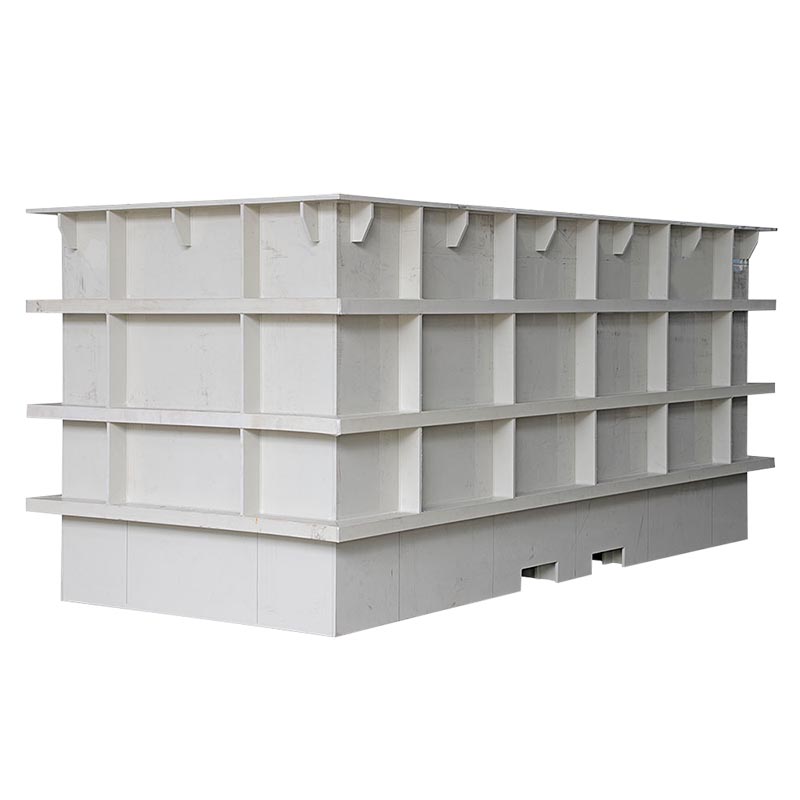
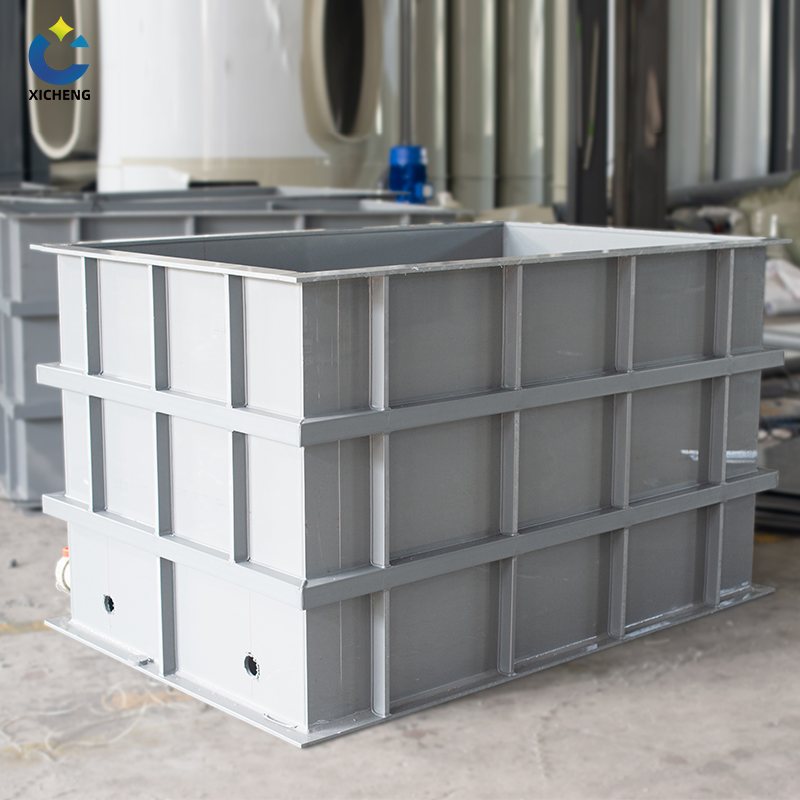
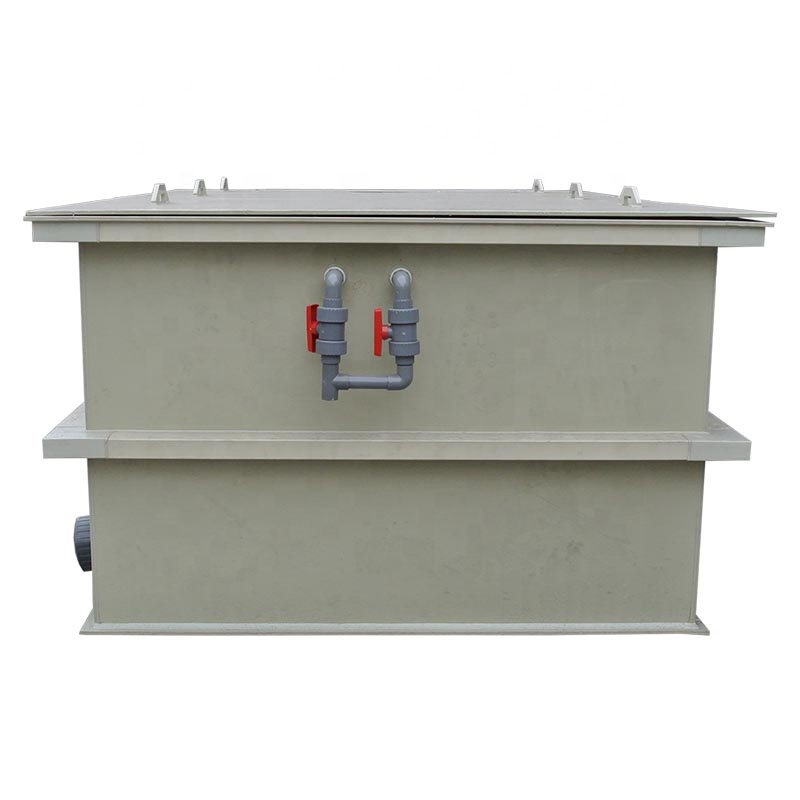
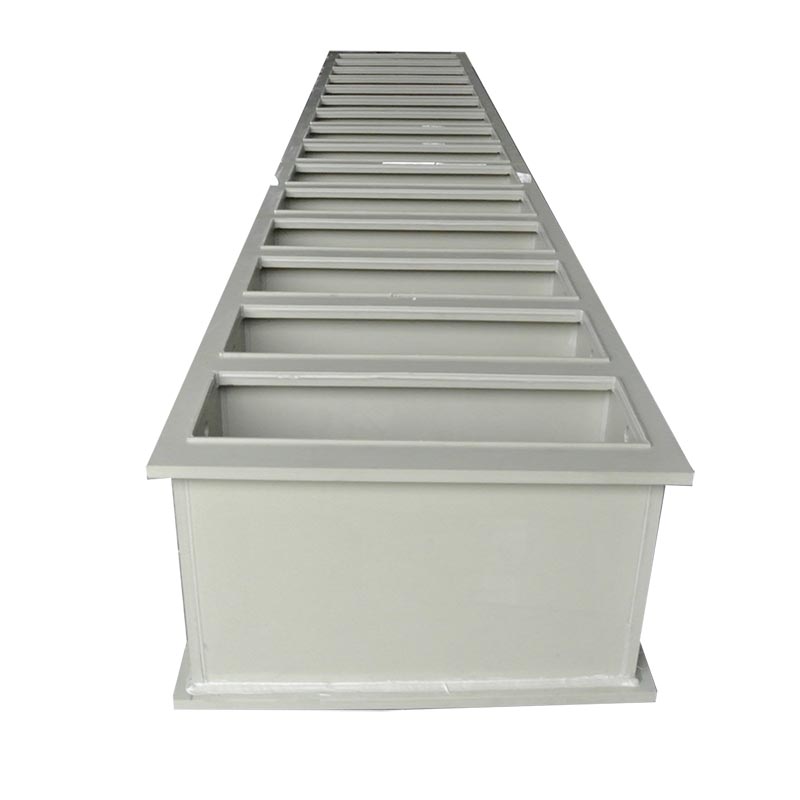
XICHENG EP manufactures pickling tanks in sizes from 100-liter bench-top laboratory units to 20,000-liter industrial immersion lines, with wall thicknesses from 10 mm to 30 mm engineered for hydrostatic load plus a 2× safety factor. Standard features include an integral PP spill containment lip, a bottom drain with PP flange and valve, lifting lugs, and external PP rib stiffeners at 500-800 mm centers for tanks exceeding 1,200 mm in any dimension. Multi-compartment tanks with internal PP baffle walls allow sequential pickling, rinsing, and passivation in a single tank unit, reducing floor space by 30-40% compared to individual tanks. All XICHENG EP pickling tanks are factory hydro-tested at 1.3× design liquid level before shipment.
Pickling Tank Product Range
PP Pickling Tank
A PP pickling tank — also called a polypropylene pickling tank or PPH pickling tank — is the standard choice for acid pickling of steel and stainless steel components at temperatures up to 70°C. The tank is fabricated from 10-25 mm PP or PPH (polypropylene homopolymer) sheet, cut to size on a CNC panel saw, and joined by hot-gas extrusion welding using PP welding rod of the same grade as the base material. The resulting monocoque structure has no metal reinforcement in contact with the process liquid — the corrosion-resistant envelope is continuous from the tank floor to the rim.
PP pickling tanks handle hydrochloric acid (5-18% at 25-60°C), sulfuric acid (5-15% at 25-70°C), phosphoric acid, and mixed nitric-hydrofluoric acid pickling solutions used for stainless steel. The tank interior is smooth with radiused corners (minimum 25 mm radius at all wall-to-wall and wall-to-floor joints) to eliminate crevices where sludge accumulates. External PP vertical rib stiffeners at 500 mm centers provide structural rigidity without internal obstructions that would trap air pockets during filling. For tanks deeper than 1,500 mm, the wall thickness steps up in 5 mm increments per 500 mm of depth to match the increasing hydrostatic pressure.
| Parameter | Specification |
|---|---|
| Volume Range | 100 — 20,000 liters |
| Wall Thickness | 10 — 25 mm (depth-dependent) |
| Max Temperature | 70°C (PP) / 85°C (PPH) |
| Material | PP-C or PPH sheet; PP welding rod |
| Joint Method | Hot-gas extrusion welding per DVS 2207-4 |
FRP Pickling Tank
An FRP pickling tank — also called a fiberglass pickling tank or fiberglass reinforced plastic pickling tank — is specified for pickling processes operating at elevated temperatures (70-95°C) or using aggressive mixed acids that degrade PP. The tank laminate uses a chemical-grade vinyl ester resin with E-glass mat and woven roving reinforcement, with a resin-rich corrosion barrier (2.5-3.0 mm, 90% resin content) at the process-contact surface backed by a structural layer (6-20 mm, 35-45% glass content) that provides the mechanical strength. The hand lay-up or filament winding fabrication produces a seamless, joint-free tank shell with integrated flange, nozzle, and stiffener geometry molded in place.
FRP pickling tanks handle the full range of pickling acids at temperatures that would soften and deform PP: sulfuric acid up to 50% at 80°C, hydrochloric acid up to 18% at 85°C, and nitric-hydrofluoric mixed acid at 50-60°C. The FRP laminate is inherently fire-retardant (ASTM E84 Class 1 with brominated resin additive) and provides approximately 3× the tensile strength of PP at equivalent thickness. FRP tanks exceeding 3,000 mm in length or height include external carbon steel or FRP structural frames to limit deflection under hydrostatic load to L/200 (span/200). FRP pickling tanks are the standard specification in steel mill push-pickling lines and tube pickling operations where operating temperature and mechanical loads exceed PP capabilities.
| Parameter | Specification |
|---|---|
| Volume Range | 500 — 20,000 liters |
| Max Temperature | 95°C (vinyl ester); 120°C (novolac VE) |
| Corrosion Barrier | 2.5-3.0 mm resin-rich layer (90% resin) |
| Material | Vinyl ester resin + E-glass reinforcement |
| Fabrication | Hand lay-up or filament winding; seamless shell |
PP Electroplating Tank
A PP electroplating tank — also called an electroplating pickling tank or plastic plating tank — is a PP fabrication designed for the electroplating process sequence: acid pickling, alkaline degreasing, electroplating (nickel, chromium, zinc, copper, tin), and post-plate rinsing. Unlike a simple pickling tank, an electroplating tank includes provisions for anode and cathode bus bars mounted along the tank rim, heating elements or heat exchanger coils for bath temperature control (typically 40-65°C), and air sparging or mechanical agitation for bath uniformity. The PP material provides electrical insulation between the tank and the plating bath, eliminating stray current corrosion that occurs with metal tanks.
Standard electroplating tank configurations include single-compartment tanks for a dedicated plating bath and multi-compartment tanks where the pickling, plating, and rinsing stages share a common PP shell with internal PP divider walls. Multi-compartment designs reduce inter-stage pipework and are standard for automated plating lines where a single transfer mechanism indexes parts through the sequence. Electroplating tanks are fabricated from 10-20 mm PP sheet with a minimum 15 mm wall thickness when heating elements are immersed in the bath. External PP structural reinforcement is spaced at 400-600 mm centers for the additional load of solution weight plus the dynamic load of part immersion and removal.
| Parameter | Specification |
|---|---|
| Volume Range | 100 — 10,000 liters |
| Wall Thickness | 10 — 20 mm (15 mm min. with heaters) |
| Max Temperature | 65°C (PP) for plating baths |
| Configuration | Single or multi-compartment with PP dividers |
| Accessories | Bus bar mounts, heater brackets, air sparge piping |
Acid Etching Tank
An acid etching tank — also called a PP etching tank or acid etching tank PP — is a PP or FRP vessel specifically designed for the chemical etching of metal surfaces using aggressive acid mixtures: ferric chloride (for copper and stainless steel etching), nitric-hydrofluoric acid (for titanium and aluminum etching), and cupric chloride (for printed circuit board etching). Etching tanks require precise temperature control — typically within ±2°C — because etch rate is strongly temperature-dependent, varying by 10-15% per degree Celsius for most etch chemistries. PP is the standard material for etching tanks operating below 60°C; FRP with vinyl ester resin is specified for nitric-HF and higher-temperature etch processes.
Etching tanks include an integral PP heating/cooling coil or external heat exchanger loop with a PP circulation pump to maintain the ±2°C setpoint. The tank lid is gasketed with EPDM or FPM and includes an exhaust port connected to a fume scrubber system — essential for nitric acid etching which generates NOx fumes. For PCB etching applications, the tank includes a titanium or PP spray bar array for even etchant distribution over the board surface. XICHENG EP etching tanks are supplied with a process-specific chemical resistance verification for the specified etchant composition, concentration, and operating temperature.
| Parameter | Specification |
|---|---|
| Volume Range | 50 — 5,000 liters |
| Temperature Control | ±2°C via integral coil or external exchanger |
| Material | PP (below 60°C) or FRP vinyl ester |
| Lid/Exhaust | Gasketed PP lid with fume scrubber port |
| Applications | PCB etching, stainless/titanium/aluminum etch |
Steel Pickling Tank
A steel pickling tank — also called a pickling tank for steel or steel strip pickling tank — is a heavy-duty PP or FRP immersion vessel sized for the pickling of steel coils, wire rod, tubes, and fabricated components in hydrochloric or sulfuric acid at volumes from 2,000 to 20,000 liters. The tank is designed for continuous or batch operation with provisions for acid circulation through an external PP heat exchanger that maintains the pickling bath at 60-85°C, where the pickling rate is 3-5× faster than at ambient temperature. An integral PP fume extraction lip around the tank perimeter captures acid mist and directs it to a fume scrubber, maintaining workplace air quality below the OSHA PEL of 5 ppm for HCl.
Steel pickling tanks in continuous strip lines incorporate submerged PP guide rolls or slide bearings for steel strip passage through the tank at line speeds up to 200 m/min. The tank floor is sloped 1-2% toward the drain with a PP sediment trap for mill scale sludge collection. For push pickling lines — where individual coils are pushed through the tank by a hydraulic ram — the tank entry and exit incorporate PP wiper seals to minimize acid drag-out. The tank exterior is protected by an acid-resistant PP or FRP secondary containment bund with 110% of the primary tank volume per EPA SPCC requirements for acid storage.
| Parameter | Specification |
|---|---|
| Volume Range | 2,000 — 20,000 liters |
| Operating Temperature | 60-85°C (PP or FRP per acid type) |
| Design | Continuous strip or batch immersion |
| Features | Fume extraction lip, sludge trap, acid circulation |
| Containment | 110% secondary bund per EPA SPCC |
PP Chemical Storage Tank
A PP chemical storage tank — also called a polypropylene chemical storage tank or PP acid storage tank — is a cylindrical or rectangular PP vessel designed for the bulk storage of corrosive chemicals at atmospheric pressure and ambient to moderate temperature. These tanks store fresh acid, prepared pickling solution, rinse water, and waste acid prior to neutralization, typically in volumes from 500 to 15,000 liters. Cylindrical vertical tanks with a flat or conical bottom are standard for bulk storage; rectangular tanks are used where floor space is constrained or where the tank serves as both storage and day-tank for a pickling line.
PP chemical storage tanks are fabricated from 8-20 mm PP sheet with external vertical and horizontal stiffener rings. The tank is closed with a bolted PP manway cover (400-600 mm diameter for tank access and inspection) and includes a vent connection sized per API 2000 for normal breathing and emergency venting. Level indication is via a PP sight tube with isolation valves or an external magnetic level gauge. For outdoor installation, UV-stabilized PP sheet with 2% carbon black prevents UV degradation of the tank shell over a 15-20 year service life. A bolted PP flange at the tank outlet connects to the chemical transfer pump suction line.
| Parameter | Specification |
|---|---|
| Volume Range | 500 — 15,000 liters |
| Configuration | Cylindrical vertical or rectangular |
| Wall Thickness | 8 — 20 mm (per liquid head + safety factor) |
| Material | PP-C natural or UV-stabilized (2% carbon black) |
| Fittings | Manway, vent, level gauge, drain flange, lifting lugs |
Pickling Tank Material Selection
| Condition | Recommended Material |
|---|---|
| HCl or H₂SO₄ pickling, ≤70°C | PP (polypropylene) 10-25 mm |
| HCl or H₂SO₄ pickling, 70-95°C | FRP vinyl ester |
| HNO₃-HF mixed acid pickling (stainless steel) | FRP vinyl ester (PP incompatible with HNO₃) |
| Electroplating baths (Ni, Cr, Zn, Cu) ≤65°C | PP with heating element provisions |
| Bulk chemical storage, outdoor | UV-stabilized PP with 2% carbon black |
Frequently Asked Questions
What is the difference between PP and FRP pickling tanks?
PP pickling tanks are fabricated by welding PP sheet and are the standard choice for hydrochloric and sulfuric acid pickling at temperatures up to 70°C. FRP pickling tanks use a fiberglass-reinforced vinyl ester laminate and are specified for higher temperatures (70-95°C), mixed nitric-hydrofluoric acid pickling, and applications requiring higher structural strength. PP provides equivalent corrosion resistance to FRP for HCl and H₂SO₄ at moderate temperatures and costs approximately 30-40% less than an equivalent FRP tank. FRP is required when nitric acid is present (PP is attacked by HNO₃ above 10% concentration) or when operating temperature exceeds PP’s continuous service rating.
What wall thickness does a pickling tank need?
Wall thickness is a function of tank depth, dimensions, and the specific gravity of the pickling solution (typically 1.1-1.2 for 10-18% HCl). The design criterion is a maximum deflection of L/200 (span/200) at the mid-span of the longest unsupported wall panel, with a 2× safety factor on the material’s allowable stress at the operating temperature. As a rule of thumb for PP tanks: 10 mm for depths up to 800 mm, 15 mm for 800-1,200 mm, 20 mm for 1,200-1,800 mm, and 25 mm for depths exceeding 1,800 mm. External PP rib stiffeners at 400-600 mm centers reduce the effective panel span and can decrease the required wall thickness by one step.
Can a single tank be used for multiple process steps?
Yes — multi-compartment PP tanks with internal PP divider walls allow pickling, rinsing, and passivation in a single tank unit. Each compartment is independently drained and has its own chemical feed and overflow connections. The divider walls are welded into the tank shell with the same material and joint quality as the external walls, providing a leak-tight barrier between compartments. This configuration reduces floor space by 30-40% and simplifies part transfer compared to individual tanks. The trade-off is that the tank volume is fixed per compartment — each compartment cannot be independently resized later.
Get a Pickling Tank Quote
XICHENG EP manufactures PP and FRP pickling tanks, electroplating tanks, etching tanks, and chemical storage tanks from 100 to 20,000 liters. Every tank is supplied with a hydrostatic test certificate, material certification, and a dimensional drawing showing all nozzle locations and stiffener positions. Contact our application engineers with your pickling chemistry, operating temperature, tank dimensions, and process flow diagram for a design proposal and quotation within 48 hours.
About XICHENG EP
XICHENG EP LTD is an industrial air pollution control equipment manufacturer with 16+ years of production experience, 2,600+ systems shipped, and installations in 60+ countries. We manufacture in China, with in‑house PP sheet extrusion, CNC cutting, hot‑gas welding, and FRP filament winding — every scrubber component from raw material to finished vessel is fabricated under one roof. No outsourced fabrication, no subcontractor delays.
Core Advantages
- In‑house manufacturing: PP fabrication, FRP winding, and electrical assembly in one facility. Material traceability from resin batch to finished system
- Pre‑assembly testing: Every scrubber is dry‑assembled and water‑tested in our shop before crating. What arrives on site fits
- Documentation package: P&ID, GA drawing, O&M manual, material certs, and performance test procedure — ready for permit submittal
- Material selection guidance: We recommend PP, FRP, or dual‑laminate based on your gas chemistry, temperature, and budget — not our inventory
- After‑sales support: Remote commissioning via video call, 10‑year spare parts availability, 1‑year warranty on workmanship and materials
Certifications and Compliance
- CE Marking — Machinery Directive 2006/42/EC, EMC Directive 2014/30/EU
- RoHS — 2011/65/EU compliant materials throughout
- ISO 9001:2015 — Quality management system
- ISO 14001:2015 — Environmental management system
- SGS material testing — PP sheet, FRP laminate, weld integrity verified
- Design basis per EU 2010/75/EU Industrial Emissions Directive
- Engineered to meet US EPA NESHAP and OSHA 1910.94
How to Order
- Send your operating data: Gas flow rate (CFM or m³/hr), contaminant type and inlet concentration (ppm), required outlet limit per your permit, gas temperature, and available site footprint. Contact our engineering team
- Receive your proposal: Within 48 hours — preliminary sizing, process flow diagram, budget price, and delivery timeline. No obligation
- Review and approve: Once the proposal meets your requirements, we issue a formal quotation with detailed technical specifications
- Drawing approval: P&ID, general arrangement, and electrical schematic for your sign‑off before fabrication begins
- Manufacturing and testing: 6‑10 weeks fabrication. Pre‑shipment water‑tightness test, recirculation test, and control system checkout
- Shipping and commissioning: Containerized sea freight or air freight worldwide. Remote commissioning support via video call included; optional on‑site supervision available
Global Shipping
We ship wet scrubber systems worldwide from our manufacturing facility in China. Regular containerized sea freight to ports in North America (Los Angeles, Houston, New York), Europe (Rotterdam, Hamburg, Antwerp), the Middle East (Jebel Ali, Dammam), Southeast Asia (Singapore, Port Klang), and Australia (Sydney, Melbourne). Air freight available for urgent deliveries and smaller systems. All equipment is crated, shrink‑wrapped, and container‑loaded with desiccant for ocean transit.
Reviews
There are no reviews yet.