
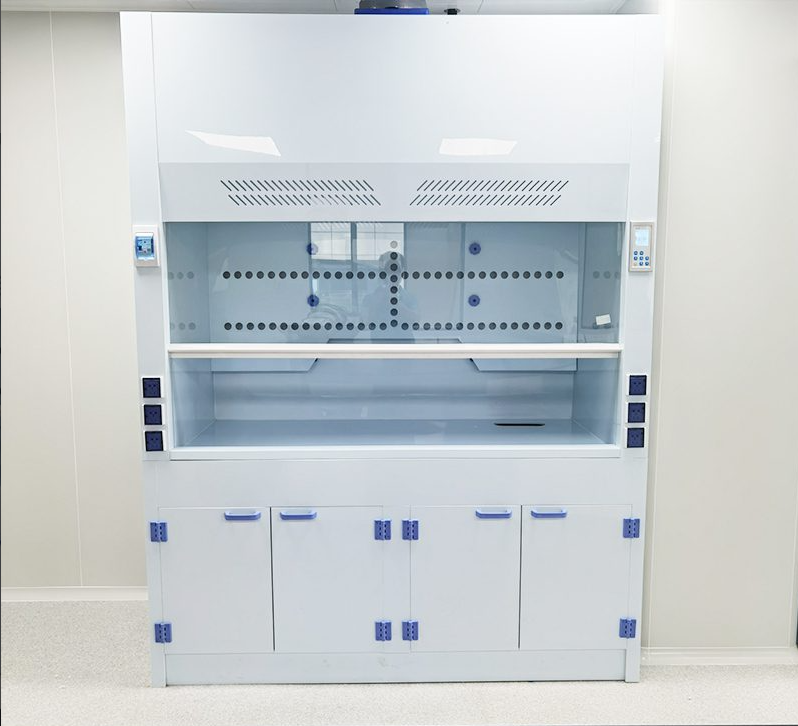
Laboratory Fume Hoods — PP/FRP Corrosion-Resistant Exhaust Enclosures
A laboratory fume hood — also called a chemical fume hood or lab exhaust hood — is a ventilated enclosure that captures and exhausts hazardous chemical vapors, acid fumes, solvent mists, and particulate generated during laboratory procedures, protecting personnel from inhalation exposure. The hood enclosure is fabricated from PP (polypropylene) or FRP (fiberglass reinforced plastic) for full corrosion resistance to acids, solvents, and oxidizing agents — unlike standard steel fume hoods that corrode internally within 2-3 years of perchloric or hydrochloric acid use. XICHENG EP manufactures PP and FRP laboratory fume hoods in ducted, ductless, walk-in, bench-top, and specialty chemical configurations, each designed to maintain a face velocity of 0.4-0.6 m/s (80-120 fpm) at the sash opening per ANSI/AIHA Z9.5 and ASHRAE 110 standards.
A PP fume hood with a constant-volume exhaust system handles 800-1,500 CFM at 0.5 inches w.g. static pressure for a standard 1.2 m (4 ft) width, using a backward-curved FRP exhaust fan mounted on the roof or in a dedicated fan room. The PP hood body is hot-gas welded from 8-10 mm PP sheet with an integral chemical-resistant work surface sloped to a front-mounted cup sink for spill containment. For perchloric acid or strong oxidizing applications, the hood interior includes a water wash-down spray system and all ductwork is vertical with no horizontal runs to prevent condensation pooling. All XICHENG EP fume hoods are factory-tested to ASHRAE 110 tracer gas containment standards before shipment.
Laboratory Fume Hood Range
PP Ducted Fume Hood
A PP ducted fume hood — also called a polypropylene fume hood or ducted PP fume hood — is a standard laboratory exhaust enclosure constructed from 8-10 mm PP sheet with a vertical sash (manual or motorized), an integral PP exhaust plenum, and a duct connection to an FRP centrifugal exhaust fan that discharges treated or untreated air outside the building. The ducted configuration provides permanent contaminant removal — all fumes exit the building through the ductwork — making it suitable for work with toxic gases, volatile solvents, and acid digestions where recirculation is prohibited by laboratory safety protocols.
Standard widths are 1.2 m, 1.5 m, and 1.8 m (4, 5, and 6 ft) with a working height of 800-900 mm and an overall height of 2,350 mm. The sash is 6 mm tempered glass or polycarbonate with a counterweight or chain-and-sprocket mechanism limiting maximum opening to 500 mm for operator protection. Interior features include a PP baffle system that directs airflow evenly across the work surface, a fluorescent or LED light fixture mounted outside the air stream behind a sealed PP window, and two 220V electrical outlets with GFCI protection. The exhaust duct connection is a 250-315 mm PP flange sized for an air velocity of 8-12 m/s in the duct to prevent condensation and droplet carryover.
| Parameter | Specification |
|---|---|
| Standard Widths | 1.2 m / 1.5 m / 1.8 m (4 / 5 / 6 ft) |
| Face Velocity | 0.4-0.6 m/s (80-120 fpm) |
| Material | 8-10 mm PP sheet; 6 mm tempered glass sash |
| Exhaust Volume | 800-1,500 CFM (1.2 m width, sash open 500 mm) |
| Standard | ASHRAE 110 / ANSI Z9.5 |
Ductless Fume Hood
A ductless fume hood — also called a ductless laboratory fume hood or recirculating fume hood — filters contaminated air through an activated carbon and/or HEPA filter stack and returns the clean air to the laboratory, eliminating the need for external ductwork, roof penetrations, and an exhaust fan. The air passes through a pre-filter (captures particulate and mist), a main activated carbon bed (adsorbs organic vapors, acid gases, and ammonia), and optionally a HEPA H14 filter (captures 99.995% of particles at 0.3 μm) before discharging back into the room through a front or top grille.
Ductless hoods are specified for laboratories where installing ductwork is impractical — historical buildings, mobile labs, temporary facilities — or where the chemicals in use are well-characterized and the carbon filter’s saturation point can be predicted. A ductless PP fume hood with a bonded carbon filter (12-15 kg activated carbon, impregnated or virgin) provides 200-400 operating hours before filter replacement at typical laboratory usage rates. Filter life is monitored by a built-in gas sensor or a timer-based alarm. Ductless hoods are NOT suitable for perchloric acid, high-volume solvent work, or unknown chemical mixtures.
| Parameter | Specification |
|---|---|
| Standard Widths | 0.8 m / 1.0 m / 1.2 m |
| Filter Stages | Pre-filter + activated carbon + optional HEPA H14 |
| Carbon Capacity | 12-15 kg (bonded bed) |
| Filter Life | 200-400 operating hours (typical) |
| Not Suitable For | Perchloric acid, high-volume solvents, unknown mixtures |
Walk-In Fume Hood
A walk-in fume hood — also called a walk-in fume hoods unit or walk-in laboratory hood — is a floor-standing PP enclosure with a full-height interior allowing personnel to enter and work inside the hood, typically used for large-scale laboratory apparatus, pilot-scale reactions, 55-gallon drum handling, and equipment that exceeds the working dimensions of a bench-top hood. The walk-in hood has a floor-level work surface (or a raised PP grating over a spill containment sump), full-height rear baffle, and either horizontal sliding doors or a vertical bifold door for equipment access.
Standard walk-in hoods are 1.2-1.8 m wide, 0.9-1.2 m deep, and 2.1-2.4 m interior height with an overall exterior height of 2.7-3.0 m. Exhaust volumes range from 2,000 to 5,000 CFM at 0.4-0.6 m/s face velocity with the doors fully open. The PP floor is reinforced to support 500 kg/m² for equipment loading. Walk-in hoods are deployed in pharmaceutical R&D, chemical pilot plants, university synthesis labs, and industrial quality control laboratories where the reaction apparatus — rotary evaporators, glass reactors, distillation columns — requires overhead clearance beyond a standard bench-top hood.
| Parameter | Specification |
|---|---|
| Interior Dimensions | 1.2-1.8 m W x 0.9-1.2 m D x 2.1-2.4 m H |
| Exhaust Volume | 2,000-5,000 CFM (doors open) |
| Floor Loading | 500 kg/m² (reinforced PP grating) |
| Material | 10-12 mm PP sheet; PP structural frame |
| Door Type | Horizontal sliding or vertical bifold |
Chemical Fume Hood
A chemical fume hood — also called a chemical fume hoods workstation or chemical exhaust hood — is a ducted PP or FRP enclosure specifically designed for handling highly corrosive chemicals: concentrated hydrochloric, sulfuric, nitric, hydrofluoric, and perchloric acids. The PP hood body provides universal acid resistance, while the FRP exhaust duct and fan handle the acid-laden saturated exhaust stream without corrosion. Standard features include an acid-resistant PP work surface with a 12 mm thick epoxy or phenolic resin top, a cup sink with a PP drain valve, and service fixtures (water, gas, vacuum) with PP or PTFE valves and nozzles mounted on the front posts.
Perchloric acid hoods require a wash-down system: spray nozzles plumbed into the hood interior and exhaust duct to periodically flush perchlorate salt deposits that can accumulate and become shock-sensitive explosives upon drying. The exhaust system for a perchloric acid hood uses a dedicated FRP fan with a water spray in the duct and no horizontal duct runs, per NFPA 45 and manufacturer requirements. XICHENG EP chemical fume hoods are supplied with a chemical resistance matrix matching the hood material to the intended acids, solvents, and reagents specified by the end user.
| Parameter | Specification |
|---|---|
| Work Surface | 12 mm epoxy/phenolic resin or PP |
| Service Fixtures | Water, gas, vacuum; PP or PTFE valves |
| Perchloric Option | Internal wash-down + vertical-only ductwork |
| Material | 8-10 mm PP; FRP exhaust duct |
| Standard | NFPA 45 / ANSI Z9.5 / SEFA 1 |
Fume Hood Exhaust System
A fume hood exhaust system — also called a fume hood ventilation system or fume exhaust hood — is the complete air handling package that connects one or more fume hoods to the outdoors: the exhaust ductwork (PP or FRP, vertical riser), the FRP centrifugal exhaust fan (roof-mounted, belt-driven), and the make-up air system that replaces exhausted air to maintain laboratory pressurization. The exhaust system is engineered as a complete package because the fan static pressure, duct diameter, and hood face velocity are interdependent — under-sizing any component results in a face velocity below 0.4 m/s and compromised containment.
A multi-hood manifold system with 4-8 fume hoods on a common duct header reduces total fan count at the cost of reduced individual hood control: sash management is critical — closing one sash increases face velocity at the remaining open hoods. A dedicated fan per hood eliminates this cross-talk but adds capital cost. Variable air volume (VAV) systems use a sash position sensor to modulate a motorized damper and VFD-controlled fan to maintain constant face velocity regardless of sash position, reducing exhaust volume (and HVAC energy) by 40-60% when hoods are closed or at minimum sash opening. XICHENG EP engineers the complete exhaust system from hood face to fan discharge — duct sizing, fan selection, VAV controls, stack design — as a single integrated package.
| Parameter | Specification |
|---|---|
| Duct Material | PP (ambient temp) or FRP (high temp/oxidizing) |
| Fan Type | Belt-driven FRP centrifugal; VFD-compatible |
| Configuration | Dedicated per hood or common manifold (2-8 hoods) |
| Control Option | Constant volume or VAV (sash-position-based) |
| Make-Up Air | Tempered or untempered; 80-90% of exhaust volume |
Bench-Top Fume Hood
A bench-top fume hood — also called a bench top ducted fume hood or benchtop laboratory hood — is the standard laboratory fume hood configuration: a PP enclosure mounted on a PP or steel support stand at a working surface height of 850-900 mm (standard bench height), with the sash, work surface, baffle, and exhaust plenum integrated into the hood superstructure. The bench-top design fits into existing laboratory bench layouts and connects to the building exhaust duct via a roof riser. Standard accessories include a base cabinet for solvent storage (vented or unvented), service turrets for water, gas, and vacuum, and a digital airflow monitor with audible/visual low-flow alarm.
Bench-top PP hoods handle the widest range of laboratory chemistry — acid digestions, solvent extractions, sample preparations, titrations, and chemical synthesis — where the scale fits within a 1.2-1.8 m bench footprint. The PP hood interior is illuminated by a vapor-proof LED fixture providing 800-1,000 lux at the work surface, and the front airfoil at the sill directs incoming air smoothly across the work surface to eliminate dead zones and eddies where contaminants can accumulate. XICHENG EP bench-top fume hoods are available in PP (standard acid service), PPs (flame-retardant, UL 94 V-0 for solvent work), and FRP (high-temperature applications up to 95°C).
| Parameter | Specification |
|---|---|
| Standard Widths | 1.2 m / 1.5 m / 1.8 m |
| Working Height | 850-900 mm (standard bench) |
| Material Options | PP (acid) / PPs V-0 (solvent) / FRP (high-temp) |
| Illumination | Vapor-proof LED, 800-1,000 lux |
| Accessories | Vented base cabinet, service turrets, airflow monitor |
Fume Hood Material Selection
PP is the standard material for laboratory fume hoods handling common acids, alkalis, and solvents at ambient temperature. When additional requirements dictate a different material, the table below guides selection:
| Condition | Recommended Material |
|---|---|
| General acids/alkalis/solvents at ambient temp | PP (polypropylene) 8-10 mm |
| Flammable solvents, fire-rated lab | PPs flame-retardant (UL 94 V-0) |
| Perchloric acid or hot acids above 70°C | FRP vinyl ester with wash-down |
| Radiochemical or particulate work | PP with HEPA H14 + carbon filter |
Frequently Asked Questions
What is the difference between ducted and ductless fume hoods?
A ducted fume hood exhausts contaminated air outside the building through a ductwork and fan system — all fumes are permanently removed. A ductless fume hood filters the air through activated carbon and returns it to the room. Ducted hoods are required for: unknown or mixed chemical use, high-volume solvent work, perchloric acid, and any application where filter breakthrough would create a personnel hazard. Ductless hoods are acceptable for well-characterized, low-toxicity chemical use in facilities where installing ductwork is not feasible. The trade-off is permanent installation cost (ducted) versus ongoing filter replacement cost (ductless).
What face velocity should a fume hood maintain?
ANSI/AIHA Z9.5 and SEFA 1 specify a face velocity of 0.4-0.6 m/s (80-120 fpm) at the maximum sash opening. Below 0.4 m/s, cross-drafts from personnel movement, door opening, or HVAC diffusers can disrupt containment. Above 0.6 m/s, turbulence at the sash opening can pull contaminants out of the hood. The target design point is 0.5 m/s (100 fpm) at a sash opening of 450-500 mm (18-20 inches). ASHRAE 110 tracer gas testing at the installed hood provides the definitive containment verification.
Can a single exhaust fan serve multiple fume hoods?
Yes — a manifold system with 2-8 hoods on a common duct header and a single FRP exhaust fan is standard in multi-hood laboratories. The design must account for diversity: not all hoods operate at full sash opening simultaneously. A VAV system with sash position sensors and motorized dampers at each hood maintains constant face velocity at each hood regardless of how many hoods are open. The alternative — one fan per hood — provides the best individual control and chemical isolation between hoods but at higher capital cost.
Get a Fume Hood Quote
XICHENG EP manufactures PP and FRP laboratory fume hoods in ducted, ductless, walk-in, bench-top, and specialty chemical configurations. Every hood is factory-tested to ASHRAE 110 and supplied with a material certificate, installation manual, and a 1-year warranty. Contact our application engineers with your laboratory layout, chemical inventory, and exhaust requirements for a hood selection and quotation within 48 hours.
About XICHENG EP
XICHENG EP LTD is an industrial air pollution control equipment manufacturer with 16+ years of production experience, 2,600+ systems shipped, and installations in 60+ countries. We manufacture in China, with in‑house PP sheet extrusion, CNC cutting, hot‑gas welding, and FRP filament winding — every scrubber component from raw material to finished vessel is fabricated under one roof. No outsourced fabrication, no subcontractor delays.
Core Advantages
- In‑house manufacturing: PP fabrication, FRP winding, and electrical assembly in one facility. Material traceability from resin batch to finished system
- Pre‑assembly testing: Every scrubber is dry‑assembled and water‑tested in our shop before crating. What arrives on site fits
- Documentation package: P&ID, GA drawing, O&M manual, material certs, and performance test procedure — ready for permit submittal
- Material selection guidance: We recommend PP, FRP, or dual‑laminate based on your gas chemistry, temperature, and budget — not our inventory
- After‑sales support: Remote commissioning via video call, 10‑year spare parts availability, 1‑year warranty on workmanship and materials
Certifications and Compliance
- CE Marking — Machinery Directive 2006/42/EC, EMC Directive 2014/30/EU
- RoHS — 2011/65/EU compliant materials throughout
- ISO 9001:2015 — Quality management system
- ISO 14001:2015 — Environmental management system
- SGS material testing — PP sheet, FRP laminate, weld integrity verified
- Design basis per EU 2010/75/EU Industrial Emissions Directive
- Engineered to meet US EPA NESHAP and OSHA 1910.94
How to Order
- Send your operating data: Gas flow rate (CFM or m³/hr), contaminant type and inlet concentration (ppm), required outlet limit per your permit, gas temperature, and available site footprint. Contact our engineering team
- Receive your proposal: Within 48 hours — preliminary sizing, process flow diagram, budget price, and delivery timeline. No obligation
- Review and approve: Once the proposal meets your requirements, we issue a formal quotation with detailed technical specifications
- Drawing approval: P&ID, general arrangement, and electrical schematic for your sign‑off before fabrication begins
- Manufacturing and testing: 6‑10 weeks fabrication. Pre‑shipment water‑tightness test, recirculation test, and control system checkout
- Shipping and commissioning: Containerized sea freight or air freight worldwide. Remote commissioning support via video call included; optional on‑site supervision available
Global Shipping
We ship wet scrubber systems worldwide from our manufacturing facility in China. Regular containerized sea freight to ports in North America (Los Angeles, Houston, New York), Europe (Rotterdam, Hamburg, Antwerp), the Middle East (Jebel Ali, Dammam), Southeast Asia (Singapore, Port Klang), and Australia (Sydney, Melbourne). Air freight available for urgent deliveries and smaller systems. All equipment is crated, shrink‑wrapped, and container‑loaded with desiccant for ocean transit.
Reviews
There are no reviews yet.